
Homicidios en Puerto Rico: Una comparación internacional

Announcements
PRVDRS
18 September 2026

Key Homicide Data in Puerto Rico: An Analysis in the International Context

The Puerto Rico Violent Death Reporting System (PRVDRS), attached to the Puerto Rico Institute of Statistics, has published a new information capsule with 2024 data analyzing the archipelago's situation compared to the rest of the world.

Below, we highlight the most relevant findings regarding the incidence of homicides in Puerto Rico and worldwide:

Puerto Rico's Position in the Region

- Homicide Rate: Puerto Rico recorded a crude rate of 15.2 homicides per 100,000 inhabitants.

- Caribbean Ranking: Among the 11 countries and jurisdictions analyzed in the Caribbean region, Puerto Rico ranks 10th, placing below jurisdictions such as the Turks and Caicos Islands (103.2), Haiti (64.3), Trinidad and Tobago (41.5), and Jamaica (40.4).

- Compared to the Regional Average: Although Puerto Rico's figure (15.2) sits below the Latin America and Caribbean average (19.3), it remains nearly three times higher than the global homicide average (5.1 per 100,000 inhabitants).

Firearm Prevalence: Puerto Rico – The Second Highest Figure in the Region

- 89.2% of Homicides Involve Firearms: Nearly 9 out of 10 homicides in the archipelago are committed using a firearm.

- Regional Leader: Alongside Saint Kitts and Nevis (89.3%), Puerto Rico presented the highest proportion of firearm homicides in all of Latin America and the Caribbean.

- International Contrast: This figure far exceeds the global average for firearm homicides (67.2%). The document emphasizes that a large portion of these incidents in Puerto Rico is related to organized crime.

Comparison by Gender and Racial Groups (Puerto Rico vs. United States)

When adjusting rates by age and comparing Puerto Rico's population with various groups in the U.S., significant disparities by sex are observed:

- Men: Men in Puerto Rico present the second-highest homicide risk rate (32.5 per 100,000 inhabitants), surpassed only by Black men in the U.S. (41.5). This figure is considerably higher than that of Hispanic men (8.6) and White men (3.6) in the U.S.

- Women: The adjusted rate for women in Puerto Rico is 3.9 per 100,000 inhabitants, placing below the risk level observed in Black women (6.9) and Native American women (5.9) in the U.S.

For more information, download the information capsule in the Access the Document section.

About the Data Source

The PRVDRS was established in 2016 with support from the Centers for Disease Control and Prevention (CDC). The system consolidates and validates information from the Bureau of Forensic Sciences, the Puerto Rico Police, and the Demographic Registry of the Department of Health to generate rigorous and internationally comparable statistics.

Links of interest: Puerto Rico Violent Death Reporting System

Share this article:

Please let us know your satisfaction level with our services.

Visit our Official Activities, and participate with us

Visit our Calls for applications and be part of the new opportunities we have for you.

If you have any questions or just want to contact us, visit the Contact Us section.

We are at your disposal. If you need custom statistics, do not hesitate to contact us.

Sign up for our online workshops. Connect with the experts and discover the power of data!

Visit our Blog and keep up to date with the latest news and topics of interest.

Visit our Press Releases and stay connected to the Institute.

Explore the Publication Calendar and keep up to date with Puerto Rico's statistics.

Complete the form for the selection of our Statistics Coordination Committee

Suscribe to receive news directly to your email.

Listen to the Official PRIS podcast and stay informed with the experts

Scientific Article: “Self-sufficiency in a Small Country?”

A new article has been added to our Virtual Library of Scientific Articles.

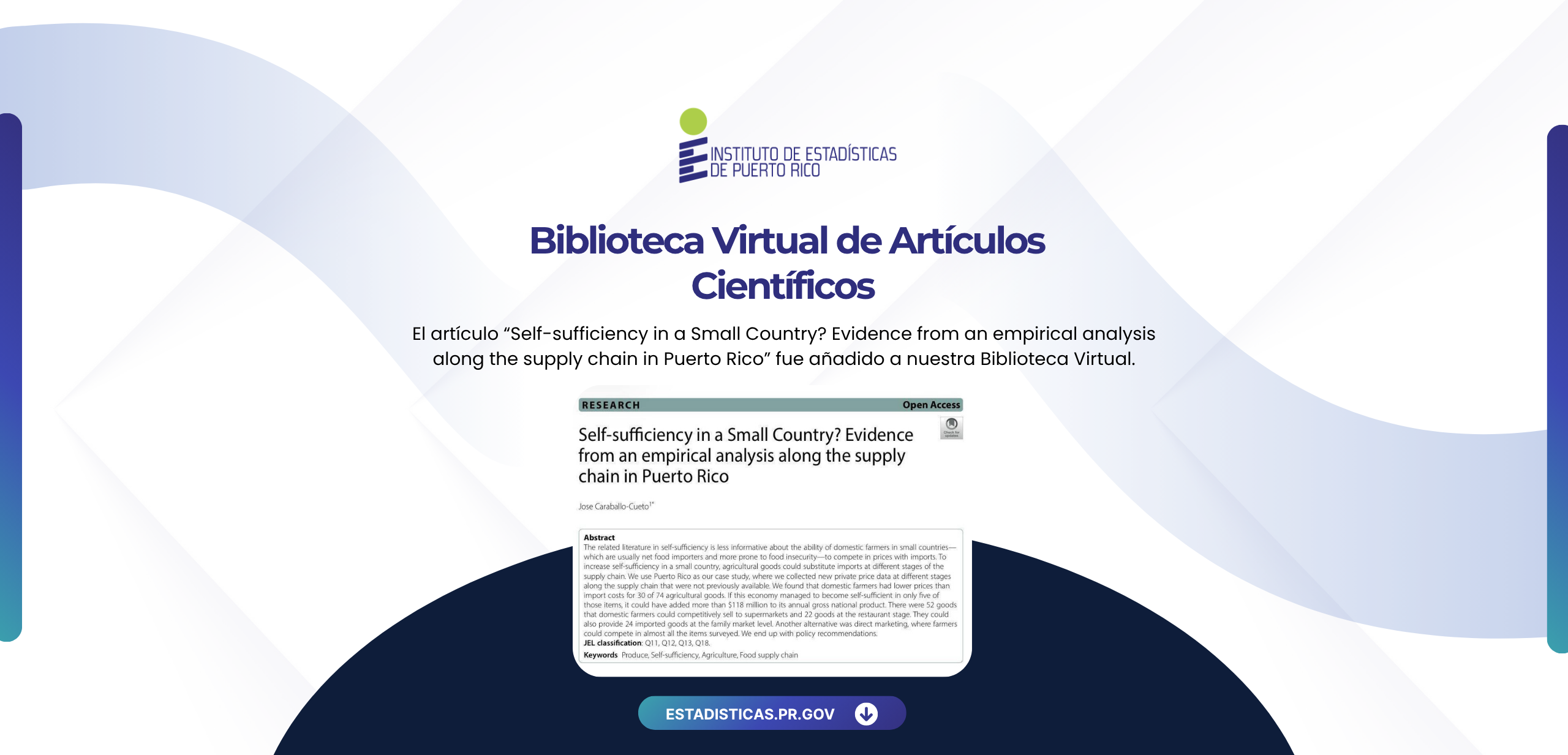
The article “Self-sufficiency in a Small Country? Evidence from an empirical analysis along the supply chain in Puerto Rico” has been added to our Virtual Library of Scientific Articles.

Access the article via the following link: https://www.estadisticas.pr.gov/productos/self-sufficiency-in-a-small-country-evidence-from-an-empirical-analysis-along-the-supply-chain-in-puerto-rico.

Statistical Glossary: Birth Rate

How many babies are born each year for every 1,000 people? This is the birth rate: a fundamental indicator for planning health and education services.

How many new members are joining our big family? The birth rate allows you to plan everything from schools to children's health services.

Nueva calculadora de costo de vida

El Instituto de Estadísticas de Puerto Rico presenta la nueva versión de la Calculadora del Índice de Costo de Vida (COLI), una herramienta interactiva diseñada para facilitar la comparación del costo de vida entre el Metropolitan Statistical Area (MSA) de San Juan–Bayamón–Caguas y aproximadamente 300 áreas urbanas de los Estados Unidos. La nueva versión incorpora una interfaz más moderna e intuitiva, mejorando la experiencia del usuario y facilitando el análisis de las diferencias en el costo de vida entre distintas regiones.

Esta nueva versión integra los datos publicados en el Informe del Índice de Costo de Vida correspondiente al primer trimestre de 2026, permitiendo a los usuarios realizar comparaciones utilizando la información oficial más reciente disponible para el área metropolitana de San Juan–Bayamón–Caguas y las demás áreas participantes del informe.

La calculadora permite comparar el costo de vida entre diferentes Metropolitan Statistical Areas (MSA), una clasificación geográfica oficial utilizada por las agencias estadísticas federales de los Estados Unidos. Las MSA están compuestas por un área urbana con una población de al menos 50,000 habitantes, junto con las áreas limítrofes que mantienen un alto grado de integración económica y social, principalmente medida mediante los patrones de desplazamiento al trabajo.

Desde el año 2015, el Instituto de Estadísticas de Puerto Rico produce el Índice de Costo de Vida (COLI) para el MSA de San Juan–Bayamón–Caguas, convirtiéndose en la fuente oficial de estas estadísticas para Puerto Rico. La publicación trimestral del informe permite que Puerto Rico forme parte de una red de aproximadamente 300 áreas urbanas de los Estados Unidos, haciendo posible realizar comparaciones metodológicamente consistentes del costo de vida entre Puerto Rico y otras jurisdicciones.

La calculadora permite comparar tanto el índice compuesto como las principales categorías, incluyendo vivienda, alimentos, transportación, cuidado de la salud, servicios públicos y bienes y servicios misceláneos. Asimismo, permite estimar el ingreso equivalente necesario para mantener un nivel de vida similar al mudarse entre distintas áreas metropolitanas, convirtiéndose en una herramienta de utilidad para ciudadanos, empresas, investigadores, universidades y agencias gubernamentales que requieren información confiable para la toma de decisiones.

Con esta nueva versión, desde el Instituto reafirmamos el compromiso con el desarrollo de herramientas innovadoras que acerquen las estadísticas oficiales a la ciudadanía y promuevan un mayor acceso a información económica de calidad. Invitamos a los usuarios a consultar el más reciente Informe del Índice de Costo de Vida y a utilizar la nueva calculadora para conocer cómo se compara el costo de vida del área metropolitana de San Juan–Bayamón–Caguas con el de aproximadamente 300 áreas metropolitanas de los Estados Unidos.

Enlaces de interés:

Nueva calculadora del Índice de Costo de Vida (COLI)

Informe trimestre 1 2026 del Índice de Costo de Vida (COLI)