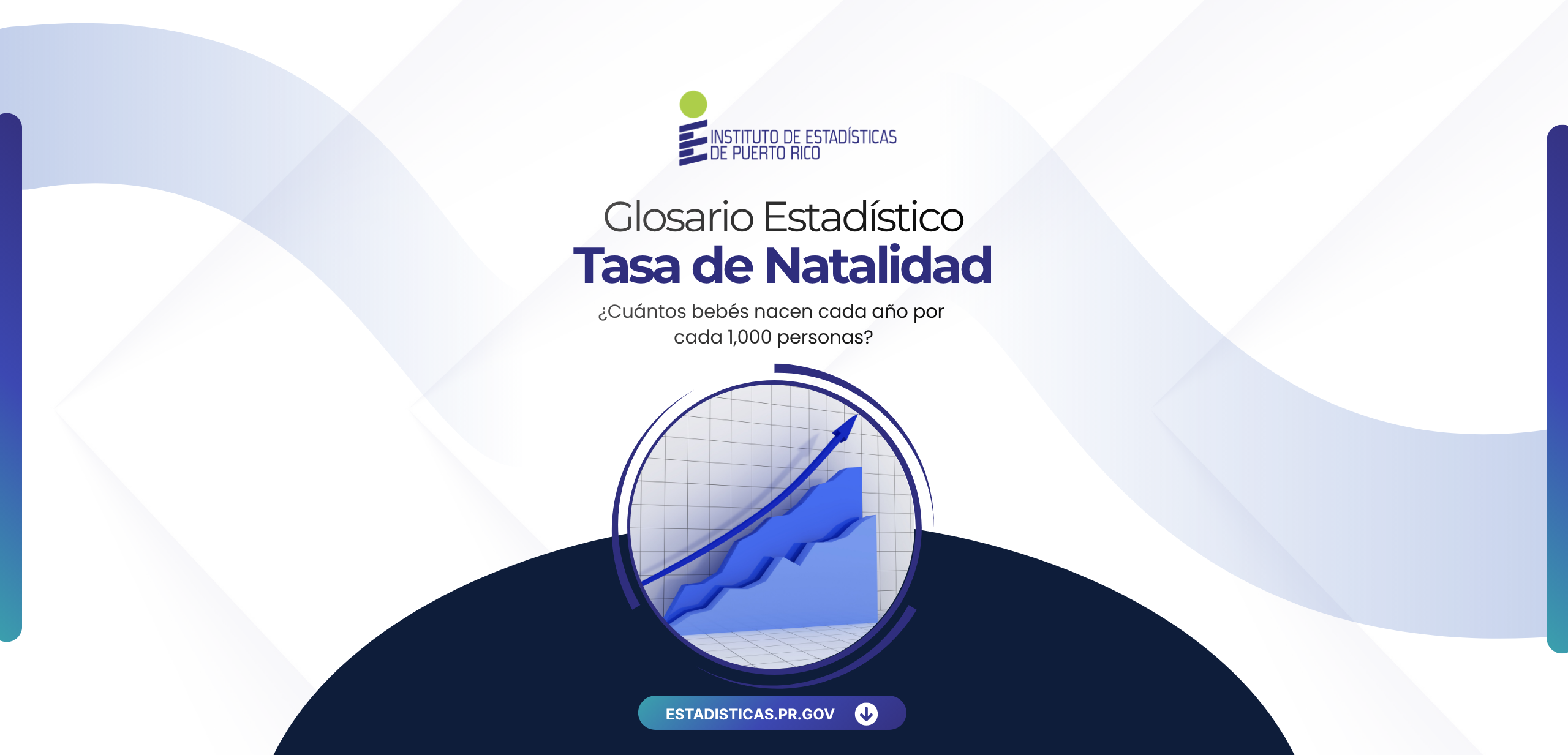
Statistical Glossary: Birth Rate

Announcements
IEPR
30 March 2026

How many babies are born each year for every 1,000 people? This is the birth rate: a fundamental indicator for planning health and education services.

How many new members are joining our big family? The birth rate allows you to plan everything from schools to children's health services.

Share this article:

Visit our Official Activities, and participate with us

Visit our Calls for applications and be part of the new opportunities we have for you.

If you have any questions or just want to contact us, visit the Contact Us section.

We are at your disposal. If you need custom statistics, do not hesitate to contact us.

Sign up for our online workshops. Connect with the experts and discover the power of data!

Visit our Blog and keep up to date with the latest news and topics of interest.

Visit our Press Releases and stay connected to the Institute.

Explore the Publication Calendar and keep up to date with Puerto Rico's statistics.

Complete the form for the selection of our Statistics Coordination Committee

Suscribe to receive news directly to your email.

Listen to the Official PRIS podcast and stay informed with the experts

Public Hearing “Protecting, Managing and Preserving Digital Evidence in Criminal Cases”

The Institute participated in the public hearing on “Protecting, Managing and Preserving Digital Evidence in Criminal Cases”.

From the Institute's perspective, the regulation of digital evidence in criminal proceedings must explicitly incorporate a statistical and data governance approach that strengthens the quality, integrity, traceability and availability of the information that underpins judicial and public policy decision-making.

The Institute recognizes the relevance of the proposed issues and supports the development of a legal framework that, in addition to establishing substantive obligations, enables the generation of indicators, standardized administrative records and interoperable systems to monitor the performance of the criminal justice system in terms of digital evidence, while respecting the principles of confidentiality, protection of personal data and fundamental rights.

Access the explanatory memorial: https://www.estadisticas.pr.gov/blogposts/memorial-explicativo-para-la-vista-publica-proteccion-manejo-y-conservacion-de-evidencia-digital-en-casos-penales

Building Statistical Capabilities for a Data-Driven World

Francisco J. Pesante Gonzalez *

Coordinator of the Academies and Workshops Program,

Puerto Rico Institute of Statistics


In an environment where public and private decisions increasingly rely on the rigorous analysis of information, the development of statistical capabilities is no longer a technical luxury, but a strategic need. Governments, companies, non-profit organizations and academic centers face the daily challenge of transforming large volumes of data into useful knowledge for planning, evaluating policies, identifying opportunities and anticipating risks.

Faced with this reality, the Academies and Workshops Program of the Puerto Rico Institute of Statistics (Institute) offers a structured response to contemporary needs in the field of data and statistics. More than isolated courses, the Institute's academic offering responds to a comprehensive curricular vision that recognizes statistical work as a continuous process that connects multiple tools, methodologies and platforms.

Statistical analysis as an integrated process

Modern statistical work begins long before analysis and continues long after producing a table or graph. It includes obtaining data, its organization, cleaning, analysis, visualization and effective communication of results. The curricular structure of the Academy Program of the Institute reflects precisely that logic: each workshop represents a piece within a chain of production of statistical knowledge.

For example, the management of census data — essential for government planning, economic development and social research — is strengthened by tools such as those offered by the Puerto Rico Community Survey and their products containing demographic and socio-economic data of the population, as well as data on household characteristics. This powerful tool not only allows access to tabulated data, but also allows the generation of thematic maps, allowing for socio-demographic analysis from a territorial perspective.

In the same way, the development of skills in Excel constitutes an essential gateway for many professionals. From this starting point, the participant can move towards business intelligence tools such as Tableau And Power BI, where data is transformed into dynamic visualizations that facilitate decision-making in public and private organizations.

R and RStudio: The Contemporary Analytical Core

One of the main axes of the program is the ecosystem of R and its integrated development environment (IDE) RStudio, one of the most used international platforms for reproducible statistical analysis. The curricular approach allows the participant to evolve from basic concepts to specialized applications.

Starting from R basic And the use of RStudio As a work environment, the workshops move towards key areas of modern analysis:

·  R Markdown: promotes reproducibility and transparency by integrating code, analysis and narrative into a single document.

·  Tidycensus: facilitates automated access to official census data.

·  Geographic Information System (GIS) with R: integrates statistical analysis with the geographical dimension, essential for territorial planning and regional analysis.

·  Webscraping: allows you to collect data from open digital sources.

·  Categorical data analysis And ggplot2: fundamental tools for exploring patterns in qualitative data and communicating results, both qualitative and quantitative, through clear and rigorous visualizations.

This approach to Academies reflects a global trend: modern statisticians not only analyze data, but also automate processes, integrate diverse sources and communicate findings effectively.

Impact on the public and private sector

The relevance of these tools transcends the academic field. In the public sector, they strengthen institutional capacity to produce higher quality official statistics, evaluate public policies and design evidence-based interventions. In the private sector, they allow us to optimize processes, understand markets, analyze customer behavior and support strategic planning.

In addition, community and non-profit organizations find in these tools an opportunity to measure social impact and support proposals with solid quantitative evidence.

Learning statistics in the digital age

The Institute Academies Program adopt educational modalities aligned with new professional dynamics. The webinars provide interactive spaces to discuss emerging issues and analyses applied to the reality of Puerto Rico. On the other hand, asynchronous workshops make it possible to develop technical competencies in a flexible way, integrating practical exercises and progressive learning.

This semester's webinar offerings include the following topics:

·  Intimate Femicide Risk Map: Sociodemographic Patterns and Prevention Measures in Puerto Rico

· 2023-2024 Migrant Profile

·  Financial Statistics

This model expands access to statistical knowledge and fosters a community of practice where professionals from different sectors share a common language based on data.

Towards a Statistical Culture

Beyond teaching about statistical information resources or Softwares Statistics, the central purpose of Academies and Workshops Program is to promote a statistical culture. This involves encouraging analytical thinking, collaborative work and the ethical use of information. The quality of the statistics produced by a country is directly linked to the preparation of people who work with data.

In that sense, the Institute's integrated curriculum design not only trains individuals, but also contributes to strengthening Puerto Rico's statistical ecosystem. Each workshop represents a step in a training path that connects tools, methodologies and real applications, preparing professionals capable of facing the challenges of a society that is increasingly guided by evidence.

The result is clear: better technical capabilities lead to better statistics, and better statistics make it possible to make better decisions for the country's economic and social development.

Don't wait any longer and enroll in the Institute's offer of workshops and webinars!


* Created with chatgpt.com

Presentation of Statistics on Pulmonary Hypertension in Puerto Rico

Puerto Rico Institute of Statistics Presents Statistics on Pulmonary Hypertension in Puerto Rico

Dr. Idania R. Rodriguez Ayuso, Deputy Executive Director of the Institute of Statistics, was a speaker at the Pulmonary Hypertension Support Group meeting. During her presentation, she presented the first statistics of pulmonary hypertension in Puerto Rico.

The results indicate that in 2024, 6,193 unique cases of pulmonary hypertension were registered: 69% in women and 31% in men. The prevalence was higher in people over 60 years of age and in the Southwest ASES region (178 cases per 100,000 inhabitants).

Access a copy of the presentation: Pulmonary Hypertension in Puerto Rico