Puerto Rico public service census database released


Download the Document
Puerto Rico public service census database released
Please let us know your satisfaction level with our services.
-p-130x130q80.png)
Visit our Official Activities, and participate with us
.png)
Visit our Calls for applications and be part of the new opportunities we have for you.
.png)
If you have any questions or just want to contact us, visit the Contact Us section.
.png)
We are at your disposal. If you need custom statistics, do not hesitate to contact us.
.png)
Sign up for our online workshops. Connect with the experts and discover the power of data!
.png)
Visit our Blog and keep up to date with the latest news and topics of interest.
.png)
Visit our Press Releases and stay connected to the Institute.
.png)
Explore the Publication Calendar and keep up to date with Puerto Rico's statistics.
.png)
Complete the form for the selection of our Statistics Coordination Committee
.png)
Suscribe to receive news directly to your email.
.png)
Listen to the Official PRIS podcast and stay informed with the experts
.png)
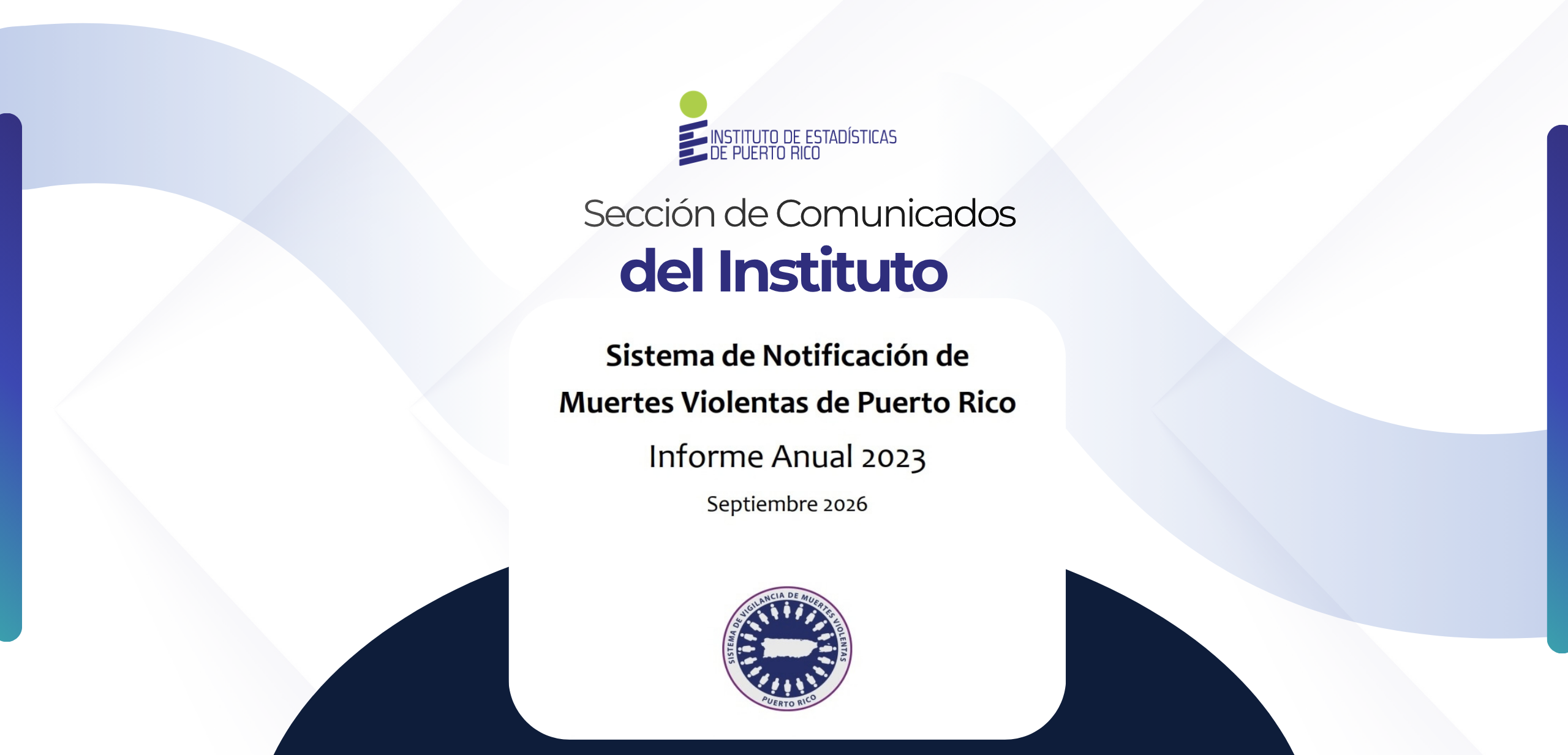
Institute of Statistics publishes the latest report on violent deaths: 733 fatalities in 2023
Institute of Statistics publishes the latest report on violent deaths: 733 fatalities in 2023
Data from the Puerto Rico Violent Death Reporting System reveals 483 homicides and 241 suicides in Puerto Rico
The Puerto Rico Institute of Statistics (Institute), through the Puerto Rico Violent Death Reporting System (PRVDRS), has presented the findings of its latest report for the year 2023. The data reveals that 674 violent death incidents were recorded in Puerto Rico, resulting in 733 fatalities.
Of the total victims reported, 483 were homicides (65.9%), 241 were suicides (32.9%), six were legal interventions (0.8%), and three were deaths of undetermined intent (0.4%), totaling 733 victims. The crude violent death rate stood at 22.9 per 100,000 inhabitants. Men accounted for nearly nine out of every 10 victims (87.4%).
Key findings from the 2023 Report:
• Homicide profile: Violence primarily affected individuals between the ages of 15 and 39. Additionally, 38.5% of homicides (186 cases) occurred in settings of collective violence linked to drug trafficking.
• Gender-based and family violence: 34 fatalities related to family violence were documented. Of the 24 cases related to intimate partner violence, 91.7% (22 victims) were women. In nearly 8 out of 10 of these femicides (77.3%), a firearm was used.
• Mental health: The suicide rate was 7.5 per 100,000 inhabitants (13.1 for men; 2.5 for women), with asphyxiation being the primary method.
• Firearm use: 90.7% of homicides in Puerto Rico were committed with firearms, compared to a global average of 55.8%.
In light of these figures, researchers at the Institute emphasized that the collection and publication of this data should serve as a catalyst for changing strategies in Puerto Rico. "Over nearly 10 years, invaluable data has been collected. This allows us to understand the magnitude of this problem from a public health perspective, identifying the contexts of violence in Puerto Rico to develop evidence-based prevention strategies for both government agencies and community organizations," stated Dr. Diego Zavala, epidemiologist and co-investigator of the PRVDRS.
For his part, Mario O. Font Martin, the PRVDRS coordinator, emphasized that "violence is a phenomenon that cannot be addressed exclusively by law enforcement agencies; it requires a comprehensive and multisectoral approach."
Marking the tenth anniversary of the PRVDRS's affiliation with the Centers for Disease Control and Prevention (CDC), the executive director of the Institute, Dr. Orville M. Disdier, highlighted the importance of the project's trajectory: "Scientific evidence shows us that violence is a modifiable behavior if we understand its causes and take appropriate preventive actions. This report is one of the primary scientific tools for promoting changes in strategy."
The 2023 Puerto Rico Violent Death Report is available on the Institute's website in the official section for the Puerto Rico Violent Death Reporting System: Puerto Rico Violent Death Reporting System - 2023 Annual Report.
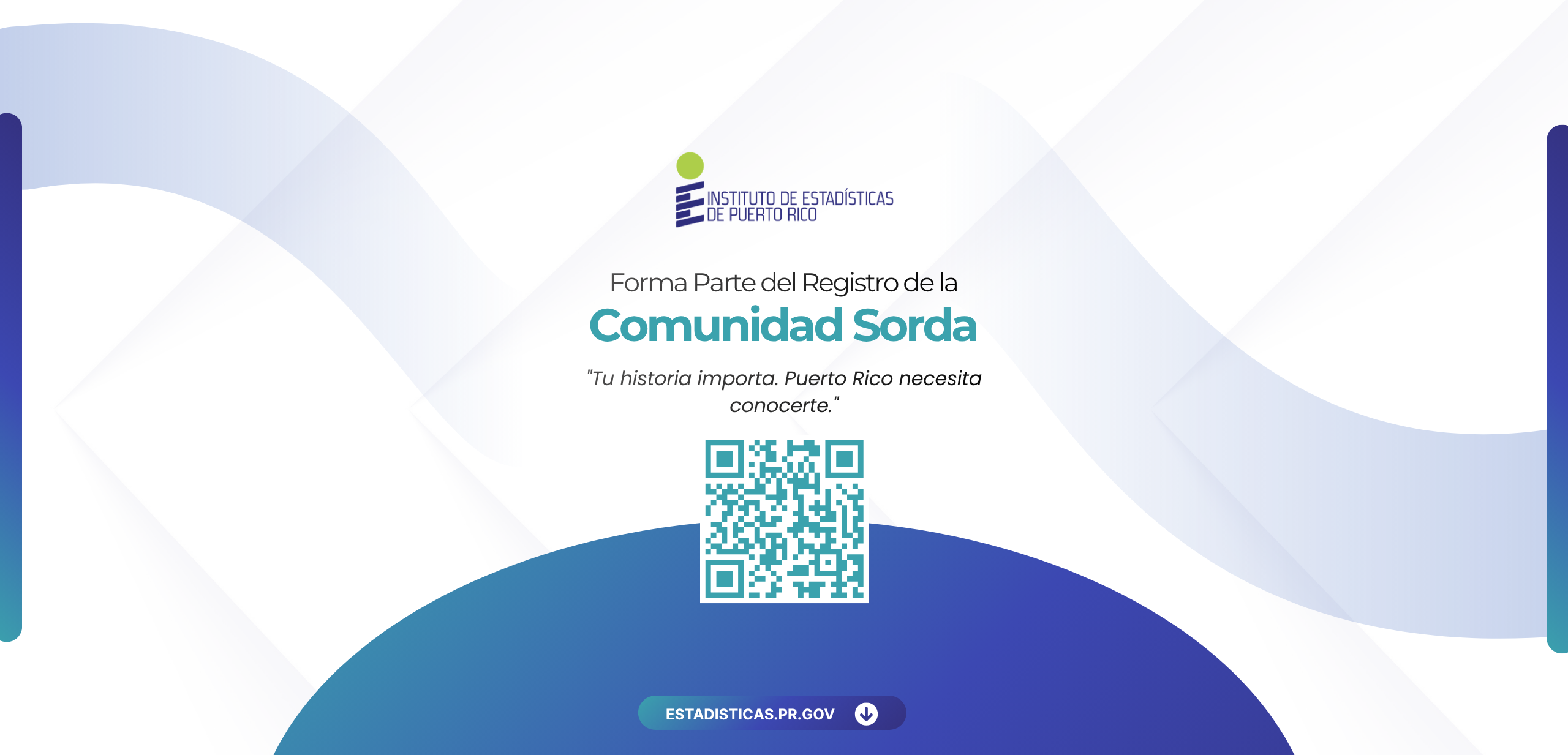
CP Deaf Community Registry
Press Release
Exhortation to the deaf community and their families to complete registration to strengthen the information available on this population in Puerto Rico
San Juan, Puerto Rico — March 18, 2026. The Puerto Rico Statistics Institute (Institute), in collaboration with the Deaf Community Liaison Office and several agencies of the Government of Puerto Rico, urged deaf people, people with partial hearing loss, deafblind people and their families to participate in an online registry that will allow the collection of key information about this population in Puerto Rico.
The initiative is developed in accordance with Executive Order OE-2026-002, issued by the governor of Puerto Rico, Jennifer A. González Colón, which instructs the Institute of Statistics, in collaboration with the Department of Health, the University of Puerto Rico, the Vocational Rehabilitation Administration, the Deaf Community Liaison Office and other entities, to carry out a formal effort to collect information about the deaf community in Puerto Rico and its characteristics, including the communication methods used.
As explained by the executive director of the Institute, Dr. Orville M. Disdier, community participation is essential for reliable information to guide public decision-making and the development of initiatives aimed at this population. “Having reliable information is essential to be able to develop public policies and services that respond to the real needs of the community. That's why we invite deaf people, those with hearing loss and their families to participate in this registry. Their participation will strengthen knowledge about this population and support informed decisions for the benefit of the deaf community in Puerto Rico,” said Disdier.
It takes three to five minutes to complete the registration. Participation is encouraged to:
- Deaf people
- People with partial (mild to moderately severe) hearing loss
- Deafblind people
- Families and caregivers who support people with these conditions
Interested persons can complete the registration at the following link: surveymonkey.com/r/deafspr
Information and guidance
Individuals or organizations interested in receiving guidance or collaborating in the dissemination of this information can contact:
Deaf Community Liaison Office (OECS)
Phone: 787-725-2333 ext. 203
VRS: 787-773-1487
Email: oecs@dpi.pr.gov
Website: www.dpi.pr.gov
Puerto Rico Institute of Statistics
Telephone: 787-819-0730
Email: preguntas@estadisticas.pr
2.3% more expensive to live in the urban area of San Juan, Bayamón and Caguas
San Juan, Puerto Rico — July 10, 2024. The Puerto Rico Institute of Statistics released the results of the Cost of Living Index (COLI) for the first quarter of 2024, whose data show that the urban area of Metropolitan Statistical Area (MSA) of San Juan-Bayamón-Caguas, is ranked 82nd out of 301 urban areas in terms of overall cost of living in the United States, with a composite index of 102.3. The 15 municipalities that make up the San Juan-Bayamón-Caguas MSA are: Bayamón, Caguas, Canovanas, Carolina, Cataño, Cidra, Dorado, Gurabo, Guaynabo, Rio Grande, San Juan, Toa Alta, Toa Baja, Trujillo Alto and Vega Alta.
At the national level, the average cost of living is set at an index of 100. The composite index of 102.3 for the urban area of the San Juan-Bayamón-Caguas MSA indicates that living in this region is 2.3% more expensive than the average of the 301 participating urban areas nationwide.
The composite index is derived from six main categories of consumer spending, of which the following table presents the Rankings for the urban area of the San Juan-Bayamón-Caguas MSA. The combination of higher costs in supermarkets and utilities is partially offset by relatively low costs in health care and miscellaneous goods.
About the Cost of Living Index (COLI):
COLI is a crucial tool for understanding regional differences in the costs of consumer goods and services. The indices are calculated based on data collected quarterly by different entities in each participating urban area. The COLI has been calculated in urban areas of the United States since 1968, using the methodology developed by the Council for Community and Economic Research (C2ER), a non-profit organization dedicated to research on community and economic development. The Puerto Rico Statistics Institute, together with the network of members affiliated with C2ER, is responsible for collecting prices for goods and services established by C2ER.
The Puerto Rico Statistics Institute has designed a comparative calculator for the cost of living between the urban area of the San Juan-Bayamón-Caguas MSA and the rest of the participating cities in the United States. This tool is available at: https://apps.estadisticas.pr/coli/.
The Puerto Rico Statistics Institute is an autonomous governmental entity responsible for coordinating the Government's statistical production service to ensure that the data collection and statistics systems, on which public policies are based, are complete, reliable, and have quick and universal access.
For more information you can visit the website: www.estadisticas.pr or write to preguntas@estadisticas.pr. They can also follow social networks through Facebook (@estadisticas .pr), X (@EstadisticasPR), LinkedIn (Institute of Statistics of Puerto Rico) and Instagram (@institutodeestadisticas) accounts.

.png)
.png)
.png)
.png)