Federal Census consults community survey users


Download the Document
Federal Census consults community survey users
Please let us know your satisfaction level with our services.
-p-130x130q80.png)
Visit our Official Activities, and participate with us
.png)
Visit our Calls for applications and be part of the new opportunities we have for you.
.png)
If you have any questions or just want to contact us, visit the Contact Us section.
.png)
We are at your disposal. If you need custom statistics, do not hesitate to contact us.
.png)
Sign up for our online workshops. Connect with the experts and discover the power of data!
.png)
Visit our Blog and keep up to date with the latest news and topics of interest.
.png)
Visit our Press Releases and stay connected to the Institute.
.png)
Explore the Publication Calendar and keep up to date with Puerto Rico's statistics.
.png)
Complete the form for the selection of our Statistics Coordination Committee
.png)
Suscribe to receive news directly to your email.
.png)
Listen to the Official PRIS podcast and stay informed with the experts
.png)
U.S. Energy Information Administration includes EEE data
PRESS RELEASE
DR. MARIO MARAZZI‐SANTIAGO
EXECUTIVE DIRECTOR
U.S. Energy Information Administration includes electricity generation data in PR
This makes it possible to individually access data from each ESA generating plant, among others.
San Juan, PR, July 12, 2018 — For the first time, data on each generating unit in Puerto Rico are accessible and have been included in the inventory of U.S. Energy Information Administration (LIA) which means a great achievement for the transparency of related information by the Electric Power Authority (EEA) and other energy companies in Puerto Rico.
This was confirmed by the Puerto Rico Statistics Institute (Institute), representative of the Government of Puerto Rico to the EIA and which has been working for several years to integrate data from Puerto Rico into the statistical inventory of that federal entity. The EIA conducts several annual and monthly surveys of companies and entities that work in the energy industry in the United States, including the electricity sector. They allow us to know in a more timely manner the evolution of Puerto Rico's energy system.
In the case of Puerto Rico, previously it only conducted an annual survey of companies and entities in this sector. Since 2014, thanks to the coordination and initiative of the Institute, the ESA began to take part and participate in monthly electricity sector surveys that allow us to perceive short-term changes in consumption and in the price paid for electricity in Puerto Rico. Now, data is added that allows us to geographically visualize where the generating plants have been located and how much each one generates, among other details. Previously, information could only be accessed globally.
The executive director of the Institute, Dr. Mario Marazzi-Santiago, stressed the importance of continuing to add ESA statistics to the monthly surveys carried out by the EIA, since they allow us to evaluate sales, consumption and price more frequently, among other important aspects. “This is another great achievement for the transparency that our government aspires to, in every area. We will have monthly indicators of the operational status of each generating unit, which can only benefit Puerto Rico, just as the Government has announced a plan to profoundly transform the Electric Power Authority,” said the Executive Director of the Institute.
The data can be accessed through the Preliminary Monthly Electric Generator Inventory. It can be seen that before 1958 all the plants were hydroelectric. While with few exceptions, those that were built and started operations between 1958 and 2009 run on oil and are still in operation. Renewable energy sources, including solar and wind, were added in 2011. After Hurricane Maria, which hit Puerto Rico in September 2017, most of the plants are operating. Some wind and solar plants have not yet been able to resume operations, but they hope to be able to do so this year.
By law, the Institute represents the Government of Puerto Rico before the EIA. In 2013, the Institute recommended that the EIA include ESA in its monthly survey. By 2014, the fruits of this initiative began to be seen with the inclusion of Puerto Rico in one of the monthly surveys. From then on, the working sessions between the EIA and the ESA were achieved, which has allowed the above-mentioned achievements.
The Puerto Rico Statistics Institute is an autonomous governmental entity responsible for coordinating the Government's statistical production service to ensure that the data collection and statistics systems, on which public policies are based, are complete, reliable, and have quick and universal access. The Institute has in its inventory, accessible through www.estadisticas.pr.gov, about 300 statistical products. In addition, it is a custodian and provides access to over 100 data sets or “data sets” through www.data.pr.gov and to over 40 tables and more than 6 thousand indicators through: www.indicadores.pr.
In addition, as the leading entity of the State Data Center (SDC) of Puerto Rico, the Institute manages the SDC portal, which contains the main statistical reports and publications of the U.S. Census Bureau on Puerto Rico, specifically those that are most in demand, such as annual population estimates; the Puerto Rico Community Survey (Puerto Rico Community Survey) and official statistics on Puerto Rico's 10-year population and housing censuses, among others. The Puerto Rico SDC portal can be accessed through: https://censo.estadisticas.pr/.
For more information you can visit our website: www.estadisticas.pr.gov. In addition, you can follow us on social networks through Facebook accounts (statistics.pr), Twitter (@EstadisticasPR) and LinkedIn (Institute of Statistics of Puerto Rico).
##
Press Contact: Sandra Morales Blanes/(787) 688-0401
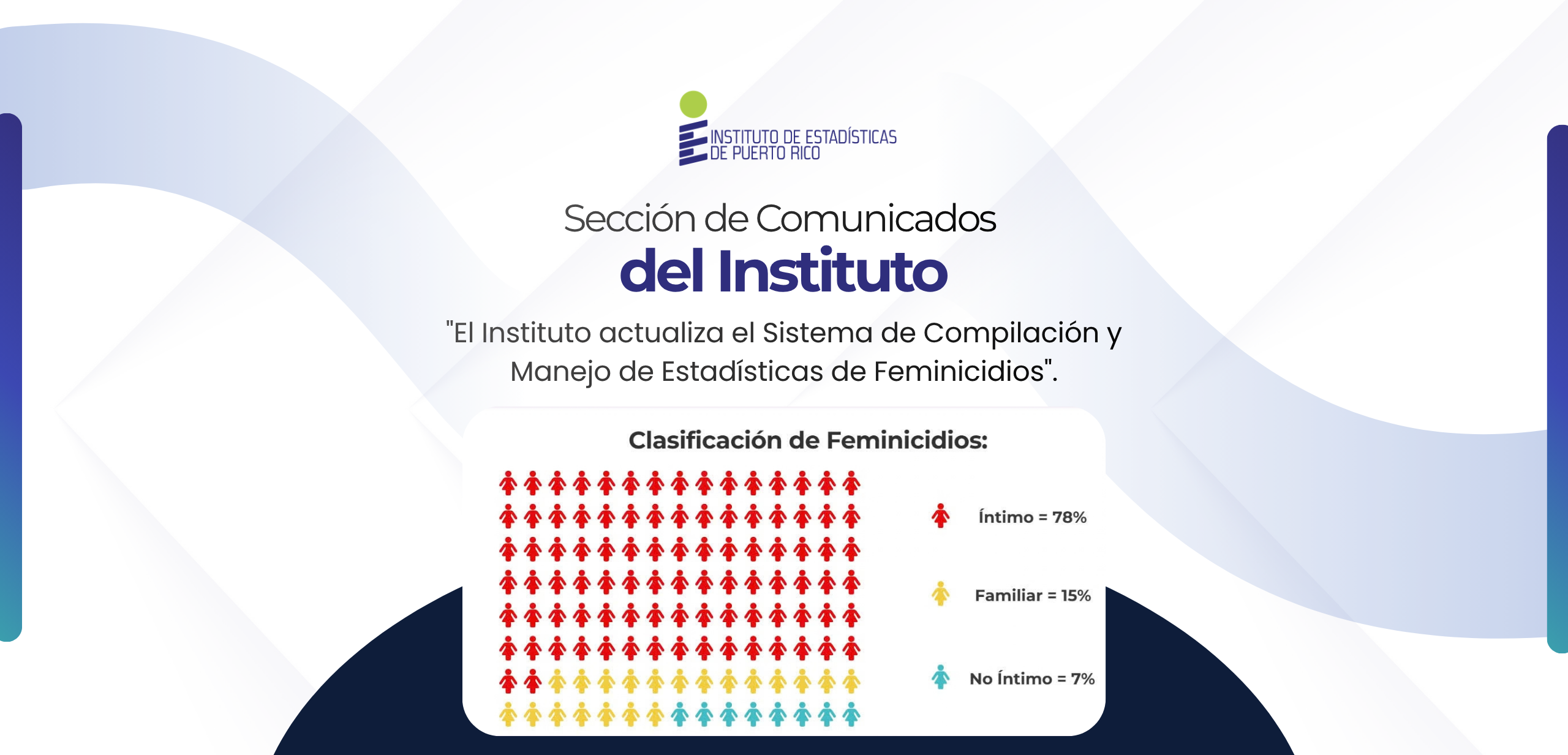
Nearly half of all homicides of women recorded in Puerto Rico between 2021 and August 2026 were femicides.
Nearly half of all homicides of women recorded in Puerto Rico between 2021 and August 2026 were femicides.
Of the 128 identified femicides, 119 were classified as intimate or familial, according to updated data from the Puerto Rico Institute of Statistics.
Of the 263 homicides of women recorded in Puerto Rico between 2021 and August 2026, 128 (48.7%) were classified as femicides. This data is derived from the update to the Puerto Rico Institute of Statistics' Femicide Statistics Compilation and Management System.
The update also reveals that 119 of the 128 femicides (93.0%) were classified as intimate or familial. In these cases, the perpetrator was the victim's partner or a family member, according to the system's classification. The portal incorporates data for 2026 and new indicators regarding the annual total of femicides and cases followed by the perpetrator's suicide. Additionally, it presents a new infographic on femicides recorded between 2021 and 2025 and a redesigned interface to facilitate data consultation and understanding. These data reflect that a significant proportion of femicides occur within the context of close relationships, highlighting the importance of examining gender-based violence and its manifestations within intimate partner and family settings.
Mariluz Bezares Salinas, Statistical Project Manager at the Institute of Statistics, stated, "This data reminds us that femicidal violence continues to claim lives in Puerto Rico and that addressing it requires a sustained response. That is why it is important to continue collecting and analyzing information that helps us better understand these cases, identify patterns, and recognize the factors associated with this issue. Continuing our research allows us to seek more effective ways to prevent and respond to these situations."
Additionally, a new infographic has been added to the femicide dashboard. It presents further information on the context of femicides that occurred during the 2021–2025 period, including the profile of the victims and the mechanism of death, among other variables. The infographic also includes sections dedicated to intimate femicides and femicides followed by the perpetrator's suicide, with specific information on the characteristics of these events.
"Continuing to make this data accessible is crucial to raising awareness of the magnitude of this problem and providing authorities and organizations with evidence-based tools that lead us toward the eradication of violence and saving lives," said Dr. Orville M. Disdier, Executive Director of the Puerto Rico Institute of Statistics.
The platform, featuring the most recent data and resources to facilitate the understanding of femicide statistics, is available on the official website of the Puerto Rico Institute of Statistics, in the Femicide Statistics Compilation and Management System section at the following link: https://www.estadisticas.pr.gov/productos/portal-del-sistema-de-compilacion-de-datos-de-feminicidios-en-puerto-rico.
Puerto Rico is included in the U.S. Cost of Living Index
Puerto Rico is included in the U.S. Cost of Living Index

.png)
.png)
.png)
.png)