Authorized Statements by Dr. Mario Marazzi-Santiago, Executive Director of the Puerto Rico Institute of Statistics, on Statistics of Occupied Government Positions
Announcements
IEPR
29 December 2025
Authorized Statements by Dr. Mario Marazzi-Santiago, Executive Director of the Puerto Rico Institute of Statistics, on Statistics of Occupied Government Positions
PRESS RELEASE DR. MARIO MARAZZI‐SANTIAGO EXECUTIVE DIRECTOR
April 13, 2018
INSTITUTE OF STATISTICS PUBLISHES SPECIAL REPORT FOR THE PREVENTION OF SCHOOL DROPOUT
The Puerto Rico Statistics Institute (Institute) today released the special report Early Detection System for School Dropouts for Public High Schools in Puerto Rico: Using Data to Provide Student Support, which provides guidance for the identification and early intervention of students who may be more likely to drop out of school before completing it.
According to the report, although the dropout rate for all grades in Puerto Rico has been decreasing (0.7% in the year 2015-2016 versus 0.9% in the year 2014-2015), the rates by educational level have been consistently higher at the higher level (high school) with 2.3% in the year 2015-2016 versus 0.7% in the intermediate level and 0.1% in the elementary level for that same year. These data justify providing special support to high school students in order to prevent them from dropping out of school.
An Early Warning System (EWS) is a series of defined and consistent procedures that, based on student data, allow the teacher to identify early students who are most likely to become school dropouts. “After the student is identified, this system allows the teacher, together with the school management, and subject to available resources, to assign the student one or more interventions with the purpose of reducing the likelihood of dropping out of school, without stigmatizing the student,” explained Dr. Orville M. Disdier, senior manager of Statistical Projects at the Institute and author of the report.
The characteristics or variables that were most important when predicting the probability of dropping out of school were: the results of standardized science tests, grades in English, grades in Spanish and unexcused absences. For example, as soon as a student scores a C in English or Spanish subjects, or accumulates 2 to 4 unexcused absences, they could be classified as having a “moderate risk of desertion”.
On the other hand, as soon as a student scores D or F in English or Spanish subjects, or accumulates a total of 5 or more unexcused absences, they could be classified as having a “high risk of desertion”. Depending on each case, the student may be assigned general or individual interventions. For example, general interventions could include sending written, telephone or electronic communications to parents/guardians and group workshops, and others. On the other hand, individual interventions could include personalized meetings and the assignment of a student mentor, among others.
With the Early Detection System or EWS, for its acronym in English, for School Dropouts, the Institute seeks to empower our teachers and principals with the best that science has to offer, in terms of early detection of students at high risk. As with almost any social problem, prevention is the key and for that we need tools to help us identify those students at risk in a timely manner.
“In order to be fully effective, of course, identification without intervention is totally ineffective. The intervention is up to teachers, principals and more broadly to the Department of Education, subject to the resources available to carry out some of these interventions. The purpose of this report is not to announce the interventions, but rather to identify students using scientific data in a way that is easy to implement in the classroom, and at the same time to appreciate how this knowledge can be used, we present some interventions that have been used in other places successfully and that in some instances already exist in Puerto Rico,” said Dr. Disdier.
For his part, Dr. Mario Marazzi-Santiago, executive director of the Institute, pointed out that Act No. 165-2011 of July 29, 2011 amended Article 1.03 of Law No. 149 of July 15, 1999 (Organic Law of the Puerto Rico Department of Education) in order for the Institute to develop, together with the Department, an EWS for school dropouts. “With the publication of this report, we are complying with our responsibility to the law, and establishing the theoretical and practical bases for the possible establishment, for the first time in Puerto Rico, of an EWS, which would unite us with the more than 31 states and territories of the United States that have this type of system,” said Dr. Marazzi-Santiago.
The Puerto Rico Statistics Institute is an autonomous governmental entity responsible for coordinating the Government's statistical production service to ensure that the data collection and statistics systems, on which public policies are based, are complete, reliable, and have quick and universal access. The IEPR has in its inventory, accessible through www.estadisticas.pr.gov, about 300 statistical products. In addition, it is a custodian and provides access to over 100 data sets or “data sets” through www.data.pr.gov And to over 40 tables and more than 6 thousand indicators through: www.indicadores.pr
In addition, as the leading entity of Puerto Rico's SDC, the IEPR manages the SDC portal, which contains the main statistical reports and publications of the U.S. Census Bureau on Puerto Rico, specifically those that are most in demand, such as annual population estimates; the Puerto Rico Community Survey and official statistics on Puerto Rico's decennial population and housing censuses, among others. The Puerto Rico SDC portal can be accessed through: https://censo.estadisticas.pr/
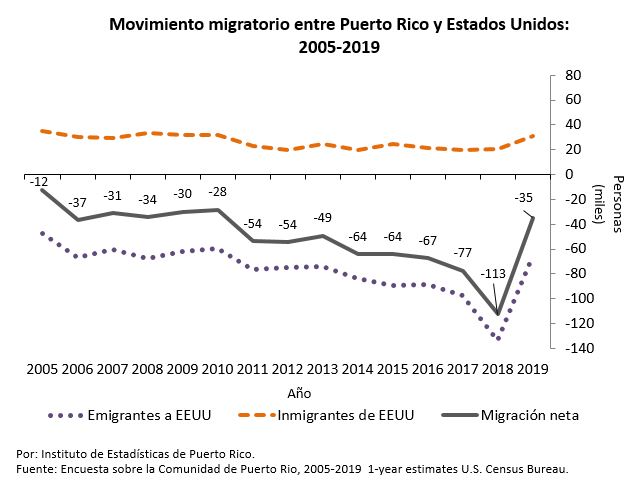
During the calendar year 2019, it was estimated, in net terms, that nearly 35,000 people immigrated to other jurisdictions in the United States. This is revealed by the most recent data from the Community Survey.
Data released by the U.S. Census Bureau covers the 2019 calendar year. The new data has been published through the new platform data.census.gov. As the local entity liaising with the U.S. Census Bureau, the Institute of Statistics shares several findings from the new 2019 data:
In 2019, Puerto Rico's migration indicators showed the following changes compared to previous years:
Around 35,000 people immigrated to other jurisdictions in the United States in net terms, representing a decrease compared to previous years (2011-2018) where the net balance ranged from 49,000 to 113,000 people migrating annually based on information from the Community Survey.
31,144 people immigrated from the United States to Puerto Rico, contrasting with an increase in immigrants of 49% compared to 2018, where an estimated immigration of 20,900 people was estimated.
66,021 people immigrated to other jurisdictions in the United States, showing a decrease from the record number in 2018, which amounted to 133,451 people.
Regarding various socioeconomic characteristics for Puerto Rico during 2019:
Some 684,655 people or 21.6% of the population (3,169,528) reported having a disability.
Around 77,000 grandparents live with their grandson or granddaughter under 18 and 32.2% of these are responsible for them.
For the population aged 25 and over (2,301,735):
78.8% had a higher education or higher education
27.2% had an education attained at the baccalaureate level or higher
39.5% and 43.5% of families and individuals, respectively, are below the poverty line.
The median household income was $20,474.
The median household income was $25,388.
The GINI index, which measures income inequality, where the value of 0 indicates that there is perfect equality and the value 1 total inequality, places Puerto Rico with an indicator of 0.5509, being the highest when compared to the states.
As for households (1,170,982), it was estimated that:
76.3% had a computer
68.2% had access to an internet subscription (broadband)
“In terms of migration, published data for 2019 point to a reduction in net migration compared to previous years. However, the fact that nearly 35,000 people have emigrated means that 1% of Puerto Rico's population declined through emigration in a single year, which has been the drastic trend throughout the decade 2010-2020,” said Alberto L. Velázquez-Estrada, Manager of Statistical Projects at the Institute.
Institute of Statistics publishes the latest report on violent deaths: 733 fatalities in 2023
Data from the Puerto Rico Violent Death Reporting System reveals 483 homicides and 241 suicides in Puerto Rico
The Puerto Rico Institute of Statistics (Institute), through the Puerto Rico Violent Death Reporting System (PRVDRS), has presented the findings of its latest report for the year 2023. The data reveals that 674 violent death incidents were recorded in Puerto Rico, resulting in 733 fatalities.
Of the total victims reported, 483 were homicides (65.9%), 241 were suicides (32.9%), six were legal interventions (0.8%), and three were deaths of undetermined intent (0.4%), totaling 733 victims. The crude violent death rate stood at 22.9 per 100,000 inhabitants. Men accounted for nearly nine out of every 10 victims (87.4%).
Key findings from the 2023 Report:
• Homicide profile: Violence primarily affected individuals between the ages of 15 and 39. Additionally, 38.5% of homicides (186 cases) occurred in settings of collective violence linked to drug trafficking.
• Gender-based and family violence: 34 fatalities related to family violence were documented. Of the 24 cases related to intimate partner violence, 91.7% (22 victims) were women. In nearly 8 out of 10 of these femicides (77.3%), a firearm was used.
• Mental health: The suicide rate was 7.5 per 100,000 inhabitants (13.1 for men; 2.5 for women), with asphyxiation being the primary method.
• Firearm use: 90.7% of homicides in Puerto Rico were committed with firearms, compared to a global average of 55.8%.
In light of these figures, researchers at the Institute emphasized that the collection and publication of this data should serve as a catalyst for changing strategies in Puerto Rico. "Over nearly 10 years, invaluable data has been collected. This allows us to understand the magnitude of this problem from a public health perspective, identifying the contexts of violence in Puerto Rico to develop evidence-based prevention strategies for both government agencies and community organizations," stated Dr. Diego Zavala, epidemiologist and co-investigator of the PRVDRS.
For his part, Mario O. Font Martin, the PRVDRS coordinator, emphasized that "violence is a phenomenon that cannot be addressed exclusively by law enforcement agencies; it requires a comprehensive and multisectoral approach."
Marking the tenth anniversary of the PRVDRS's affiliation with the Centers for Disease Control and Prevention (CDC), the executive director of the Institute, Dr. Orville M. Disdier, highlighted the importance of the project's trajectory: "Scientific evidence shows us that violence is a modifiable behavior if we understand its causes and take appropriate preventive actions. This report is one of the primary scientific tools for promoting changes in strategy."


-p-130x130q80.png)
.png)
.png)
.png)
.png)
.png)
.png)
.png)
.png)
.png)
.png)
.png)

.png)
.png)
.png)
.png)