Six municipalities with at least 60% of their population living in poverty
They are located in the center and south-west according to the Map Series of the Puerto Rico Census Data Network
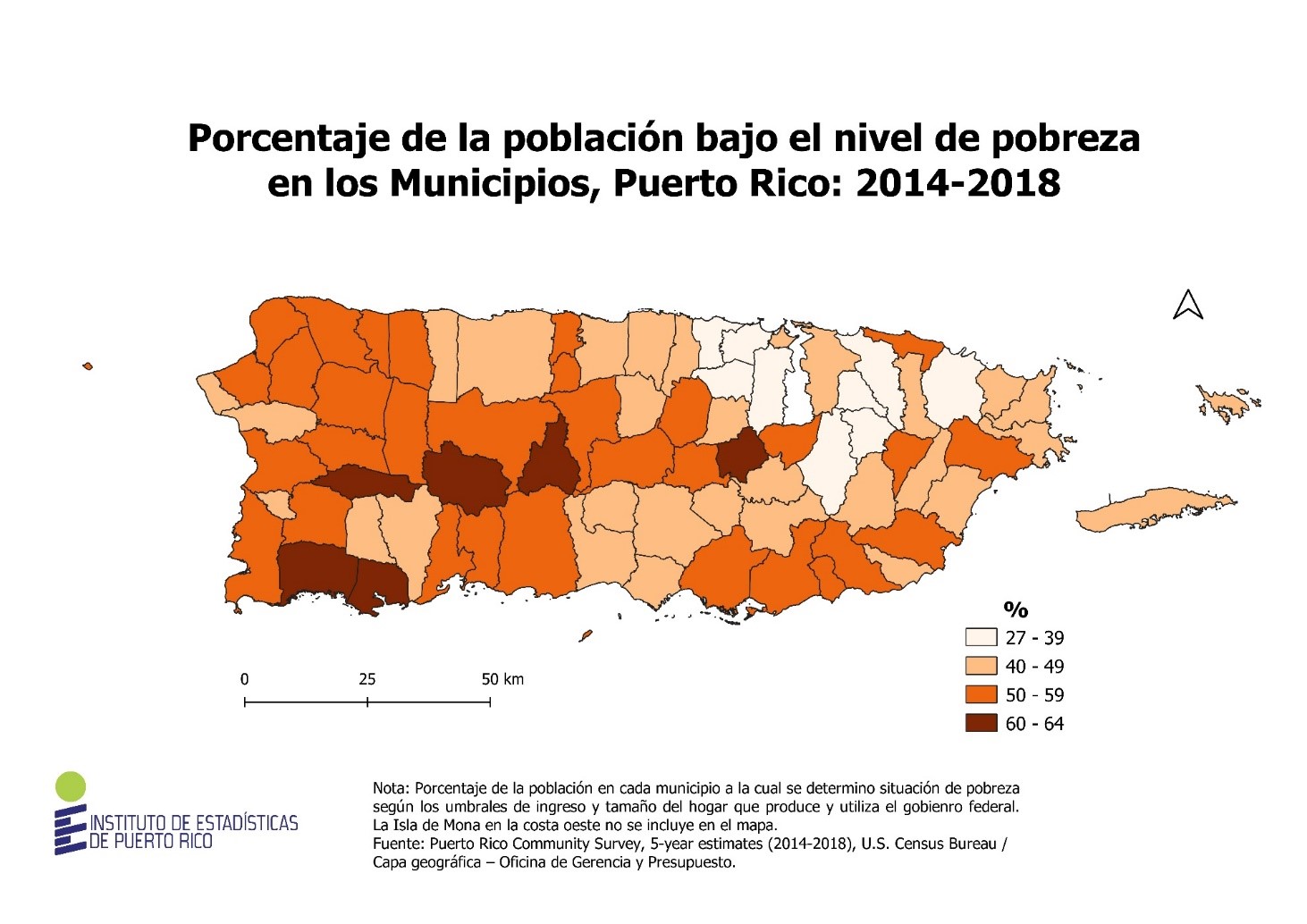
San Juan, PR, November 17, 2020 — The percentage of people living in poverty shows that six municipalities have between 60% and 64% of their population with this characteristic. The geographical distribution shows that they are located in the center and southwest of Puerto Rico, these being Maricao, Guánica, Adjuntas, Lajas, Jayuya and Comerío. La Selected Indicator Map Series includes the information collected during the period 2014-2018 through the Community Survey carried out by U.S. Census Bureau. This series includes ten indicators on demographic, social and economic topics at the level of municipalities and neighborhoods in Puerto Rico.
In addition, with information from the same period (2014-2018), the Socio-Demographic Profiles of Puerto Rico's Electoral Districts Which are divided volume IandII, with the 8 Senate Districts and with the 40 Representative Districts respectively. These provide a detailed photograph of each electoral district with essential information to know the particularities of the population that resides in each of them.
Both new products (Map and Profile Series) are part of the publications of the Puerto Rico Census Data Network (SDC-PR by its acronym in English). All of them can be accessed free of charge on the SDC-PRcenso.estadisticas.pr. As a local liaison entity with the U.S. Census Bureau, the Institute of Statistics shares several findings from the Selected Indicator Map Series:
Among the 10 municipalities with the highest percentage of children under 18, eight of them were in the southern and central region of Puerto Rico. On the other hand, the 4 municipalities with the lowest percentage of minors were Guaynabo, and to the west Rincón, Mayagüez and Hormigueros.
The highest percentages of the 18-64 year old population were in 7 municipalities, these being Toa Alta, Aguada, Morovis, and in the central-eastern area Cidra, Gurabo, Juncos and San Lorenzo. On the other hand, the municipalities with the lowest percentages of the population aged 18-64 are located mainly in the southwest (Hormigueros, San Germán, Sabana Grande, Lajas and Guánica) and to the east (Fajardo, Ceiba and Culebra).
The municipalities with the highest percentage of elderly people (65+) are shown to be in the western area of Hormigueros, San Germán, Lajas and Rincón.
Municipalities with the highest percentages (80%-84%) of people with a higher education level or higher are geographically concentrated in the metropolitan area, in addition to Santa Isabel on the south coast. On the other hand, the two municipalities with the lowest percentage of education attained are located in the midwest (Maricao and Las Marías).
As for the population with disabilities (reported on their own account), 6 of the 10 municipalities with the highest percentages (Cayey, Cidra, Comerío, Aguas Buenas, Naranjito and Orocovis) are geographically concentrated in the central area, and the other 4 municipalities are located in the south-west (Guánica, Sabana Grande, Hormigueros and Yauco). On the other hand, a concentration of municipalities in the south-east region reflected hundreds of children with disabilities (< 15%), with 9 of the 13 municipalities in this category including the island municipalities of Vieques and Culebra.
In the metropolitan region, east and south, most of the municipalities with the highest percentage (50%-74%) of households with access to broadband internet are clustered. In a situation of lower access, some 4 municipalities in the western region showed that they had less than 35% of their homes with internet access, these being Lajas, Cabo Rojo, Maricao and Las Marías.
In percentage terms, the population in 37 municipalities around Puerto Rico was shown to have half of its population or more (50% +) living in poverty. Municipalities with the lowest percentage of people in poverty are located in the metropolitan area with the exception of the municipalities of San Juan and Cataño.
Regarding family income across municipalities, this indicates that about 7 municipalities (Gurabo, Trujillo Alto, Dorado, Carolina, Toa Alta, Culebra and Bayamón) showed a median of between $30,000 and $39,000 in family income. The municipality with the highest median household income was Guaynabo ($44,000).
The highest percentage of people in the workforce (50%-57%) are mostly municipalities in the metropolitan area and the Northeast, where 11 of the 13 municipalities with this characteristic are located, Culebra and Juana Diaz the only ones outside these regions.
“The series of maps provides a geographical perspective on features of interest within Puerto Rico. The behavior of geographical patterns could support government and community management, analysis for decision-making, and stimulate research. In the same sense, the profiles of the electoral districts serve as basic metrics for current and future public policy that affects the residents of these regions.” said Alberto L. Velázquez-Estrada, Manager of Statistical Projects at the Institute.
The Puerto Rico Statistics Institute is an autonomous governmental entity responsible for coordinating the Government's statistical production service to ensure that the data collection and statistics systems, on which public policies are based, are complete, reliable, and have quick and universal access. In addition, as the leading entity of the SDC in Puerto Rico, the Institute manages the SDC portal, which contains the main statistical reports and publications of the U.S. Census Bureau on Puerto Rico, specifically those that are most in demand, such as annual population estimates; the Puerto Rico Community Survey (Puerto Rico Community Survey) and official statistics on Puerto Rico's 10-year population and housing censuses, among others. The Puerto Rico SDC portal can be accessed through: https://censo.estadisticas.pr/.
For more information you can visit our website: www.estadisticas.pr.gov. In addition, you can follow us on social networks through Facebook (@estadisticas .pr), Twitter (@EstadisticasPR) and LinkedIn (Institute of Statistics of Puerto Rico) accounts.
INSTITUTE WILL CONTINUE TO INVEST IN PLANNING BOARD STATISTICS
The decision makes it easier for the Planning Board to comply with the methodological changes
required for Puerto Rico's economy to be included in that of the United States
San Juan, PR, July 6, 2018 — The Puerto Rico Statistics Institute (Institute) announced today that its Board of Directors recently approved continuing to financially support the work of the Roadmap for the Modernization of Puerto Rico's Economic Accounts, work plan agreed between the Planning Board (JP) and the Institute for necessary improvements to Puerto Rico's macroeconomic accounting methodologies.
East Roadmap includes the need to invest in the information systems used by JP to prepare Puerto Rico's economic accounting statistics. In fact, the Institute has been investing in these systems for more than a year. Specifically, in 2016 it was entrusted to the company Wovenware the migration of information systems from a technology based on Oracle products to one based on Microsoft SQL. This is because Oracle discontinued technological support for Softwares that JP uses, which caused processing problems in that agency.
The recent decision, for example, extends this agreement to the next fiscal year, during which it is expected that Wovenware complete final phases 3 and 4 for which the Institute will be investing more than $300,000. The project, which began in 2016 and is expected to end in 2019, will allow the database to be updated automatically, duplicate data to be eliminated and processes to be improved as well as the accessibility of JP statistics.
“As part of our mission to objectively support public administration, the Institute's Board of Directors has done its part to continue the necessary improvements in government, at times of great uncertainty. It is also a project supported by the employees of the JP and the President of the JP that will allow this agency to evolve and for which we are investing more than 10% of the Institute's budget,” said the executive director of the Institute, Dr. Mario Marazzi-Santiago.
“It is worth noting that this project implements some of the methodological changes adopted by the Institute's Board of Directors in the Resolution No. 2014-02, so that Puerto Rico's national accounts are more reliable, comparable and quickly and universally accessible. At the same time, we are complying with the federal government's requirements for Puerto Rico's economy to be included in the statistics of the United States economy,” added Dr. Marazzi-Santiago.
A recent report from the Government Accountability Office (GAO), entitled Puerto Rico: Limited Federal Data Hinder Analysis of Economic Condition and Dol's 2016 Overtime Rule, found that the lack of federal data on Puerto Rico's economy had made it difficult to analyze the impact of a labor standard proposed by former President of the United States, Barack Obama, on overtime pay for certain types of jobs.
“For statistics on the Puerto Rico economy to be included in those of the United States economy, the Government of Puerto Rico must do its part as well. Since 2011, the federal Government has written down the methodological changes that need to be made to the Planning Board. It is important that this agenda be continued. The Institute's Board of Directors has done its part, because it has the expertise, professionalism, seriousness and independence of judgment that are necessary to understand that this is an agenda that is too important to be derailed,” said Dr. Marazzi-Santiago.
The Puerto Rico Statistics Institute is an autonomous governmental entity responsible for coordinating the Government's statistical production service to ensure that the data collection and statistics systems, on which public policies are based, are complete, reliable, and have quick and universal access. The Institute has in its inventory, accessible through https://estadisticas.pr.gov, about 300 statistical products. In addition, it is a custodian and provides access to over 100 data sets or “data sets” through https://data.pr.gov and to over 40 tables and more than 6 thousand indicators through: https://www.indicadores.pr.
In addition, as the leading entity of the State Data Center (SDC) of Puerto Rico, the Institute manages the SDC portal, which contains the main statistical reports and publications of the U.S. Census Bureau on Puerto Rico, specifically those that are most in demand, such as annual population estimates; the Puerto Rico Community Survey (Puerto Rico Community Survey) and official statistics on Puerto Rico's 10-year population and housing censuses, among others. The Puerto Rico SDC portal can be accessed through: https://censo.estadisticas.pr.


-p-130x130q80.png)
.png)
.png)
.png)
.png)
.png)
.png)
.png)
.png)
.png)
.png)
.png)

.png)
.png)
.png)
.png)