Statistics Institute announces inclusion of Electric Power Authority data in monthly survey of the U.S. Energy Information Administration


Download the Document
Statistics Institute announces inclusion of Electric Power Authority data in monthly survey of the U.S. Energy Information Administration
Please let us know your satisfaction level with our services.
-p-130x130q80.png)
Visit our Official Activities, and participate with us
.png)
Visit our Calls for applications and be part of the new opportunities we have for you.
.png)
If you have any questions or just want to contact us, visit the Contact Us section.
.png)
We are at your disposal. If you need custom statistics, do not hesitate to contact us.
.png)
Sign up for our online workshops. Connect with the experts and discover the power of data!
.png)
Visit our Blog and keep up to date with the latest news and topics of interest.
.png)
Visit our Press Releases and stay connected to the Institute.
.png)
Explore the Publication Calendar and keep up to date with Puerto Rico's statistics.
.png)
Complete the form for the selection of our Statistics Coordination Committee
.png)
Suscribe to receive news directly to your email.
.png)
Listen to the Official PRIS podcast and stay informed with the experts
.png)
Generosity Report 2015-2023
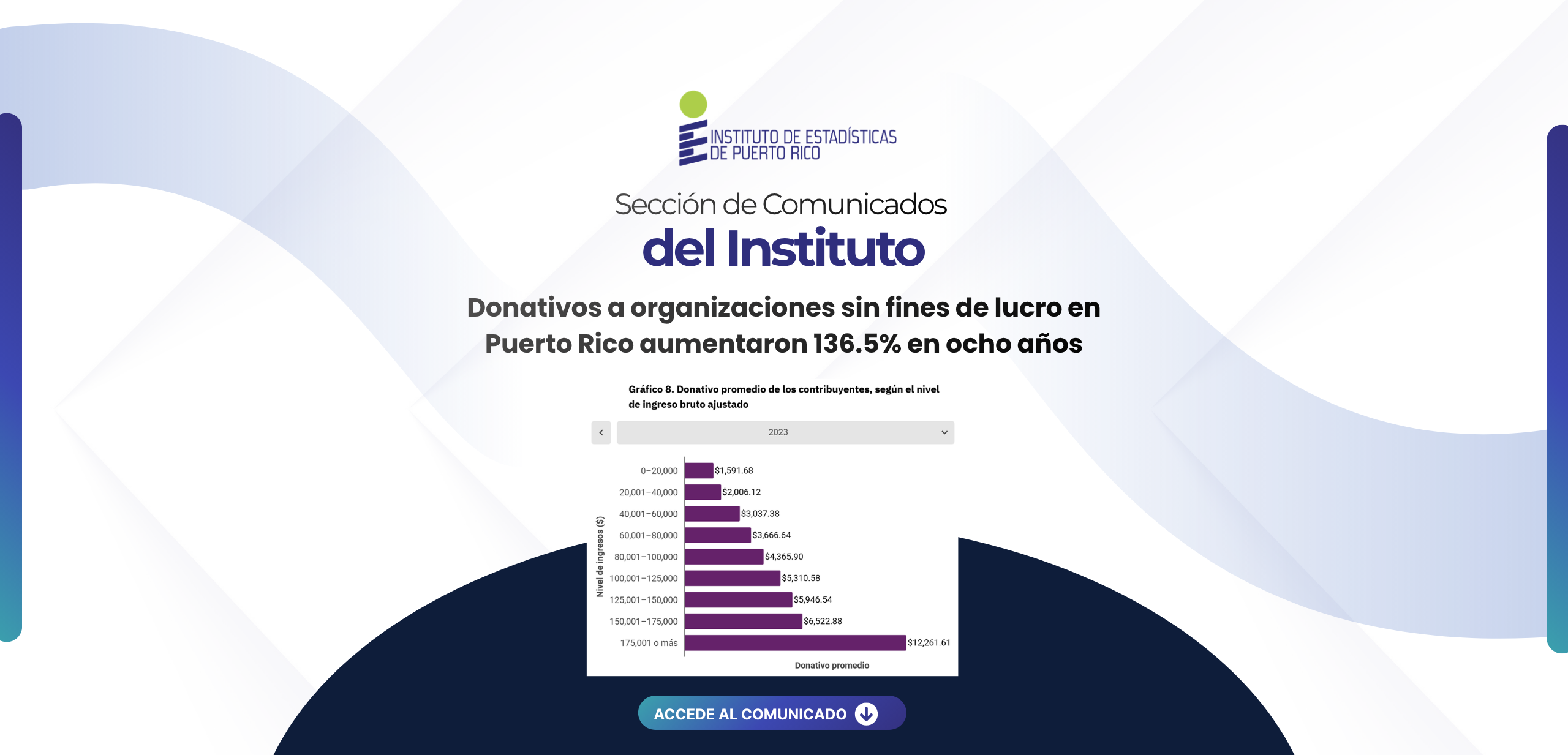
Donations to non-profit organizations in Puerto Rico increased 136.5% in eight years
Report from the Institute of Statistics and UPR reveals that donations deducted from payroll exceeded $329 million in 2023
The Puerto Rico Institute of Statistics and the Graduate School of Public Administration (EGAP) of the University of Puerto Rico published the new Generosity Report 2015-2023, an analysis that reveals sustained growth in monetary donations reported by taxpayers in Puerto Rico over the past eight years.
The report, based on official data from the Department of Treasury on deductions claimed for donations to non-profit organizations, shows that total monetary donations increased from $139.5 million in 2015 to $329.8 million in 2023, representing a cumulative increase of 136.5%.
The analysis also reveals that, during the period studied, taxpayers in Puerto Rico claimed an average of $231.9 million annually in deductions for donations. The largest annual increase occurred between 2020 and 2021, when deductions grew 19.6%, a behavior that coincides with the period after the pandemic and multiple emergencies that impacted Puerto Rico.
“The report confirms that in Puerto Rico there is a culture of support and solidarity that deserves to be documented and studied in greater depth. This data allow us to begin to measure Puerto Rico's philanthropic behavior, using official and comparable information,” said Dr. Luz Mairym López-Rodríguez, associate professor at EGAP and project manager.
The doctor added that “the preparation of this report represents an opportunity for Puerto Rico to join the discussion on generosity, particularly in the context of Latin America and the Caribbean. In addition, it will make it possible to promote academic research based on concrete data.” He also expressed his gratitude to Omar Álvarez González, the Institute's statistical project assistant, for his collaboration in the development of the report.
“In many jurisdictions around the world, there are efforts to measure and document the ecosystem of generosity. In Puerto Rico, there is still little statistical information on this topic, so this report represents an important step in generating comparable data and bringing a new dimension to the economic and social analysis of Puerto Rico,” said Dr. Orville M. Disdier Flores, executive director of the Institute of Statistics.
Disdier also mentioned that “non-profit organizations and philanthropy are an important part of the social and economic fabric of Puerto Rico, and having official statistics on generosity allows us to better understand how people support community, educational, cultural and health causes, among others. That is why we welcomed the collaboration proposed by Dr. Luz Mairym López-Rodríguez to develop this analysis.”
The report also includes interactive graphics and maps that allow us to visualize trends and compare the behavior of deductions for donations over time. Although the total amount of donations increased, the study points out that the number of taxpayers who claimed deductions for donations showed a reduction during the period analyzed, suggesting that the average contributions claimed are higher than a decade ago.
The report is available at: Generosity Report 2015-2023.
Creative Industries represent about 6% of sales in Puerto Rico companies.
Creative Industries represent about 6% of sales in Puerto Rico companies.
Statistics Institute requests information stipulated by law from government agencies
PRESS RELEASE
Statistics Institute asks government agencies
information stipulated by law
Statistical information was requested from 38 government agencies
San Juan, PR, August 5, 2020 — The Puerto Rico Statistics Institute (Institute) reported that it recently requested in writing from 38 government agencies specific statistical information, as established in multiple laws in Puerto Rico. The initiative aims to ensure compliance with Article 13 of the Institute's Organic Law, Act No. 209 of August 28, 2003, as amended, which provides that all government agencies have the obligation to regularly and constantly send to the Institute any publication of statistical products they produce, in order to be incorporated into the Inventory of Statistics and to make them available to all citizens.
The Inventory of Statistics, specified by Article 5 (f) of the Institute's Organic Law, is where most of the statistical information collected by the Institute is kept and made available to the public, and is located online at: Inventory-of-statistics. It is the main source for those looking for official statistical information that describes, estimates or analyzes the characteristics of Puerto Rico and its society. The Inventory contains all important statistical activities carried out or planned to be carried out by government agencies, as well as information on how to obtain statistical reports for Puerto Rico that are prepared by government agencies and public corporations in Puerto Rico, municipalities and any other jurisdiction in the United States. Statistical reports from the private sector are also included in the Inventory.
The deadline given to agencies to respond is 20 calendar days, but agencies can request an extension, particularly if they receive multiple requests for statistical information. This is the case of agencies to which numerous laws that specify the generation of statistical information that is of great legislative interest apply, such as the Department of Education, the Department of Natural and Environmental Resources, the Department of Health and the Department of Public Safety. However, most of the government agencies contacted will receive few requests for statistical information and are not considered less important by the Institute. It should be noted that the Institute has tried to make the process for submitting the requested statistical products as efficient as possible, making it one that can be carried out completely online.
“We urge all government agencies contacted to provide the requested statistical information. The collaboration of government agencies will help the Puerto Rico Statistics Institute expand and keep its Statistics Inventory up to date. In addition, since these are statistical products specified by legal provisions, the information requested is particularly relevant to the decision-making processes of the Government of Puerto Rico,” said Jacobo M. Orenstein-Cardona, special assistant to the Institute's executive director and coordinator of this initiative.
About the Puerto Rico Institute of Statistics
The Puerto Rico Statistics Institute is an autonomous governmental entity tasked with coordinating the government's statistical production service to ensure that the data collection and statistics systems, on which public policies are based, are complete, reliable, and accessible quickly and universally.
For more information you can visit the website: https://estadisticas.pr.gov/. In addition, you can follow the Institute on social networks, through Facebook (@estadisticas .pr), Twitter (@EstadisticasPR) and LinkedIn (Institute of Statistics of Puerto Rico) accounts.

.png)
.png)
.png)
.png)