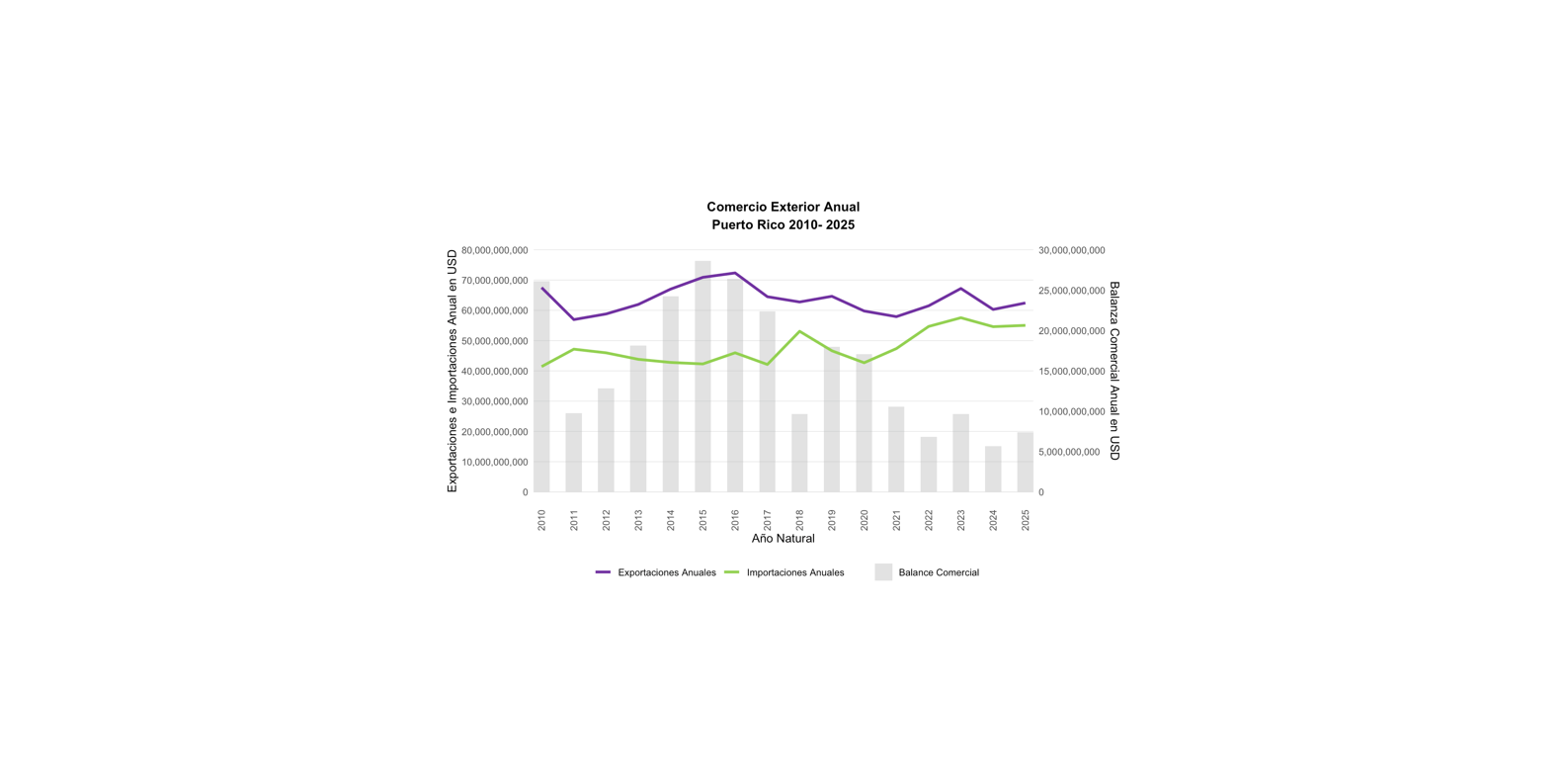
The beginning of the recession coincides with the beginning of major emigration in the last decade.
PRESS RELEASE
Puerto Rico Commission for Suicide Prevention and Statistics Institute publish statistical report for 2019
For the year 2019, 176 cases of suicide were reported, 67 cases less than in 2018
Dr. Orville M. Disdier, executive director of the Puerto Rico Statistics Institute (Institute) reported that a collaboration with the Commission for Suicide Prevention (CPS), attached to the Puerto Rico Department of Health, resulted in the “Annual Statistical Report on Deaths by Suicide 2019”.
“This report is of great importance for citizens, since it presents data on suicide for 2019 and draws comparisons with previous years. In addition, it collects data not only on fatal suicide events, but it also presents information on calls to the ASSMCA PAS line and, for the first time, includes data on suicide attempts and contemplations attended by the Emergency Medical Corps,” said Myribel Santiago, manager of statistical projects at the Institute and co-author of the publication.
The publication of this report underlines the importance of the Institute in coordinating the statistical production service of government entities. The Institute has the capacity not only to request statistical information from executive branch agencies, but also to provide them with collaboration, advice and the necessary tools to improve the quality of the statistics they produce.
“Despite the extraordinary circumstances we currently live in, we hope to continue collaborating. Today, more than ever, we need reliable and accurate data to facilitate the implementation of a responsible, informed and sensitive public policy to the complex reality we live in,” said Dr. María Isabel Coss, educational coordinator of the CPS and lead author of the publication.
For his part, Dr. Disdier argued that “the results of this collaborative report reflect that in 2019, a crude suicide rate of 5.5 per 100,000 inhabitants was observed, which is the lowest rate since 2000. Without a doubt, this is very positive and it also demonstrates the enormous importance of continuing to support the preparation of this type of report, since it is only with data that we can know if the prevention measures are giving the desired results”.
The CPS is responsible for promoting, developing, implementing, coordinating actions and strategies for suicide prevention, adopting an integrative and interdisciplinary approach aimed at individuals, families, communities at risk, and helping professionals. In addition, it emphasizes research, the development of prevention and intervention programs and
in raising public awareness of the magnitude and seriousness of suicide in Puerto Rico. For its part, the Institute is a governmental entity whose mission is to guarantee Puerto Rico that it has complete, reliable statistics, and quick and universal access.
You can access this annual report and other related reports through the following link: Suicide Statistics.
To learn more about the Institute of Statistics, you can access the website: www.estadisticas.pr.gov. On social media through Facebook (@estadisticas .pr), Twitter (@EstadisticasPR) and LinkedIn (Institute of Statistics of Puerto Rico) accounts.
###
Contacts:
Idia M. Martinez, R-28, 787-603-3200
Lourdes Burgos, R-27, 787-562-2932
Statistics Institute and Department of Education announce agreement to improve quality and access to non-confidential school statistics
PRESS RELEASE
DR. MARIO MARAZZI‐SANTIAGO
EXECUTIVE DIRECTOR
April 13, 2018
INSTITUTE OF STATISTICS PUBLISHES SPECIAL REPORT FOR THE PREVENTION OF SCHOOL DROPOUT
The Puerto Rico Statistics Institute (Institute) today released the special report Early Detection System for School Dropouts for Public High Schools in Puerto Rico: Using Data to Provide Student Support, which provides guidance for the identification and early intervention of students who may be more likely to drop out of school before completing it.
According to the report, although the dropout rate for all grades in Puerto Rico has been decreasing (0.7% in the year 2015-2016 versus 0.9% in the year 2014-2015), the rates by educational level have been consistently higher at the higher level (high school) with 2.3% in the year 2015-2016 versus 0.7% in the intermediate level and 0.1% in the elementary level for that same year. These data justify providing special support to high school students in order to prevent them from dropping out of school.
To access the full report you can visit the following link: 694ec0e7b7a478691ca522cc_IEPR_Perfil_de_Emisiones_Toxicas_2016.pdf
An Early Warning System (EWS) is a series of defined and consistent procedures that, based on student data, allow the teacher to identify early students who are most likely to become school dropouts. “After the student is identified, this system allows the teacher, together with the school management, and subject to available resources, to assign the student one or more interventions with the purpose of reducing the likelihood of dropping out of school, without stigmatizing the student,” explained Dr. Orville M. Disdier, senior manager of Statistical Projects at the Institute and author of the report.
The characteristics or variables that were most important when predicting the probability of dropping out of school were: the results of standardized science tests, grades in English, grades in Spanish and unexcused absences. For example, as soon as a student scores a C in English or Spanish subjects, or accumulates 2 to 4 unexcused absences, they could be classified as having a “moderate risk of desertion”.
On the other hand, as soon as a student scores D or F in English or Spanish subjects, or accumulates a total of 5 or more unexcused absences, they could be classified as having a “high risk of desertion”. Depending on each case, the student may be assigned general or individual interventions. For example, general interventions could include sending written, telephone or electronic communications to parents/guardians and group workshops, and others. On the other hand, individual interventions could include personalized meetings and the assignment of a student mentor, among others.
With the Early Detection System or EWS, for its acronym in English, for School Dropouts, the Institute seeks to empower our teachers and principals with the best that science has to offer, in terms of early detection of students at high risk. As with almost any social problem, prevention is the key and for that we need tools to help us identify those students at risk in a timely manner.
“In order to be fully effective, of course, identification without intervention is totally ineffective. The intervention is up to teachers, principals and more broadly to the Department of Education, subject to the resources available to carry out some of these interventions. The purpose of this report is not to announce the interventions, but rather to identify students using scientific data in a way that is easy to implement in the classroom, and at the same time to appreciate how this knowledge can be used, we present some interventions that have been used in other places successfully and that in some instances already exist in Puerto Rico,” said Dr. Disdier.
For his part, Dr. Mario Marazzi-Santiago, executive director of the Institute, pointed out that Act No. 165-2011 of July 29, 2011 amended Article 1.03 of Law No. 149 of July 15, 1999 (Organic Law of the Puerto Rico Department of Education) in order for the Institute to develop, together with the Department, an EWS for school dropouts. “With the publication of this report, we are complying with our responsibility to the law, and establishing the theoretical and practical bases for the possible establishment, for the first time in Puerto Rico, of an EWS, which would unite us with the more than 31 states and territories of the United States that have this type of system,” said Dr. Marazzi-Santiago.
The Puerto Rico Statistics Institute is an autonomous governmental entity responsible for coordinating the Government's statistical production service to ensure that the data collection and statistics systems, on which public policies are based, are complete, reliable, and have quick and universal access. The IEPR has in its inventory, accessible through www.estadisticas.pr.gov, about 300 statistical products. In addition, it is a custodian and provides access to over 100 data sets or “data sets” through www.data.pr.gov and to over 40 tables and more than 6 thousand indicators through: www.indicadores.pr
In addition, as the leading entity of Puerto Rico's SDC, the IEPR manages the SDC portal, which contains the main statistical reports and publications of the U.S. Census Bureau on Puerto Rico, specifically those that are most in demand, such as annual population estimates; the Puerto Rico Community Survey and official statistics on Puerto Rico's decennial population and housing censuses, among others. The Puerto Rico SDC portal can be accessed through: https://censo.estadisticas.pr/
For more information you can visit our website: www.estadisticas.pr.gov. In addition, you can follow us on social networks through Facebook accounts (statistics.pr), Twitter (@EstadisticasPR) and LinkedIn (Puerto Rico Institute of Statistics).
##
Press Contact: Sandra Morales Blanes (787) 688-0401

.png)
.png)
.png)
.png)
.png)
.png)
.png)
.png)
.png)
.png)
.png)

.png)
.png)
.png)
.png)