THE POPULATION OF PUERTO RICO IS ESTIMATED AT 3.2 MILLION IN 2018
With the post-hurricane effect, it points to a decrease of 14% since the 2010 Decennial Census
San Juan, PR — El U.S. Census Bureau released today the most recent annual population estimates for Puerto Rico. These statistics refer to July 1, 2017 and include the components of annual population change since July 1, 2010, which support the population estimate since the beginning of the decade. As the leading entity of the Network State Data Center (SDC) of the U.S. Census Bureau in Puerto Rico, the Puerto Rico Statistics Institute (Institute) presents this summary of the findings of the new annual population estimates for 2018:
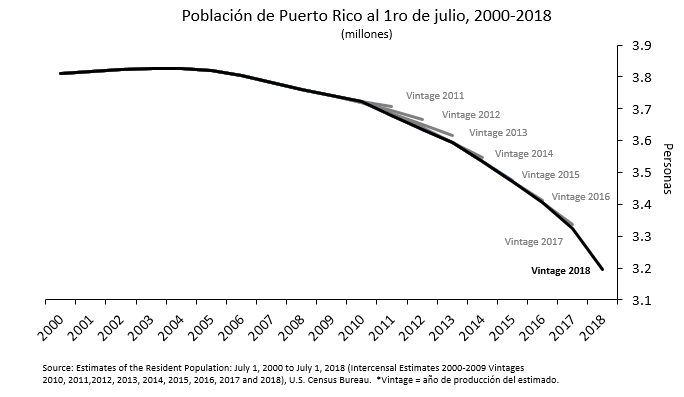
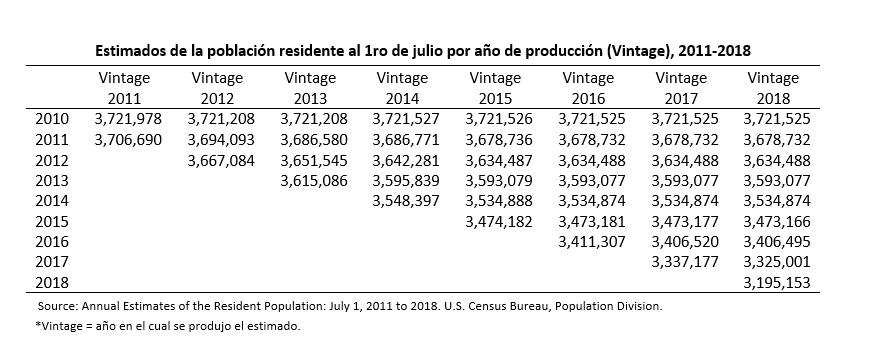
The population of Puerto Rico was estimated at 3,195,153 people as of July 1, 2018.
The impact of the hurricanes (Irma and María) in 2017 is included in the new estimates. These hurricanes further fueled the downward trend in population size in Puerto Rico. The absolute population change between July 2017 and 2018 was estimated to be close to 130,000 inhabitants, representing 3.9% of the total population.
Compared to the last 2010 Census, when the official list resulted in 3,725,789 people, the new estimate points to a cumulative decrease in the current decade of close to 14% until 2018.
In relation to the resident population 18 years of age or older (of voting age), this was estimated at 2,601.142 million, comprising 81 percent of the population in Puerto Rico.
The components of population change include that, between July 1, 2017 and July 1, 2018, about 24,000 births and 31,000 deaths occurred in Puerto Rico. As a result, annual population estimates reflect more deaths than births, resulting in a natural increase close to -6 thousand people. Regarding migration, the estimated net balance was approximately -123 thousand people during the same period.
“The 2018 population estimates give a little more detail to the repercussions of the hurricanes of the past year 2017 on the demographic components of Puerto Rico. The combination of a negative natural increase in the population (more deaths than births), combined with the drive of the already high net emigration, points to an impressive population loss of 3.9% in just one year. This presents us with a difficult scenario to assimilate in terms of the speed of the decrease, as well as the direct repercussions it entails on the local scene. On the other hand, the operations of the next Decennial Census 2020 are becoming more important, so that they result in the best possible official enumeration, then you can confirm the drastic demographic changes estimated during the current decade,” said Alberto L. Velazquez Estrada, Manager of Statistical Projects at the Institute.
After the completion of a Decennial Census (such as the 2010 Census) the U.S. Census Bureau prepare the annual population estimates, which allow us to approximate the population during the decade before the next Census. These estimates are prepared by analyzing data on births, deaths and migration. As a result, with each new publication of the estimates, adjustments are made to the previously estimated years. For example, with the publication of the 2018 estimates announced in this release, the estimates already published for 2011, 2012, 2013, 2014, 2015, 2016 and 2017 were revised. Each publication is distinguished according to the year in which they were produced and are named as Vintage.
More statistics on Puerto Rico's annual population estimates can be obtained at: https://censo.estadisticas.pr/EstimadosPoblacionales, in the population estimates section. Information on the methodology used to produce the estimates can be accessed hither.
The Puerto Rico Statistics Institute is an autonomous governmental entity responsible for coordinating the Government's statistical production service to ensure that the data collection and statistics systems, on which public policies are based, are complete, reliable, and have quick and universal access. The Institute has in its inventory, accessible through www.estadisticas.pr.gov, over 300 statistical products. In addition, it is a custodian and provides access to over 100 data sets or Data sets by means of www.data.pr.gov and to over 40 tables and more than 6 thousand indicators through: www.indicadores.pr
For more information you can visit our website: www.estadisticas.pr.gov. In addition, you can follow us on social networks through Facebook accounts (statistics.government.pr), Twitter (@EstadisticasPR) and LinkedIn (Institute of Statistics of Puerto Rico).
San Juan, Puerto Rico — November 6, 2025 — The Institute of Statistics released the results of the Backwater Index for Puerto Rico, a study that offers a comprehensive look at the social and economic situation of Puerto Rico's municipalities. This index constitutes an analysis and planning tool that seeks to promote dialogue, reflection and informed action for the benefit of Puerto Rico's socioeconomic development.
El Lagging Index measures a multidimensional phenomenon using a summary data that allows us to compare the relative performance of municipalities in two dimensions: Economic Mobility and Demography. Five main variables were considered in its design: the percentage of people below the poverty level, the unemployment rate, the percentage of high school graduates (in a population aged 18 and over), the dependency rate by age and the median age.
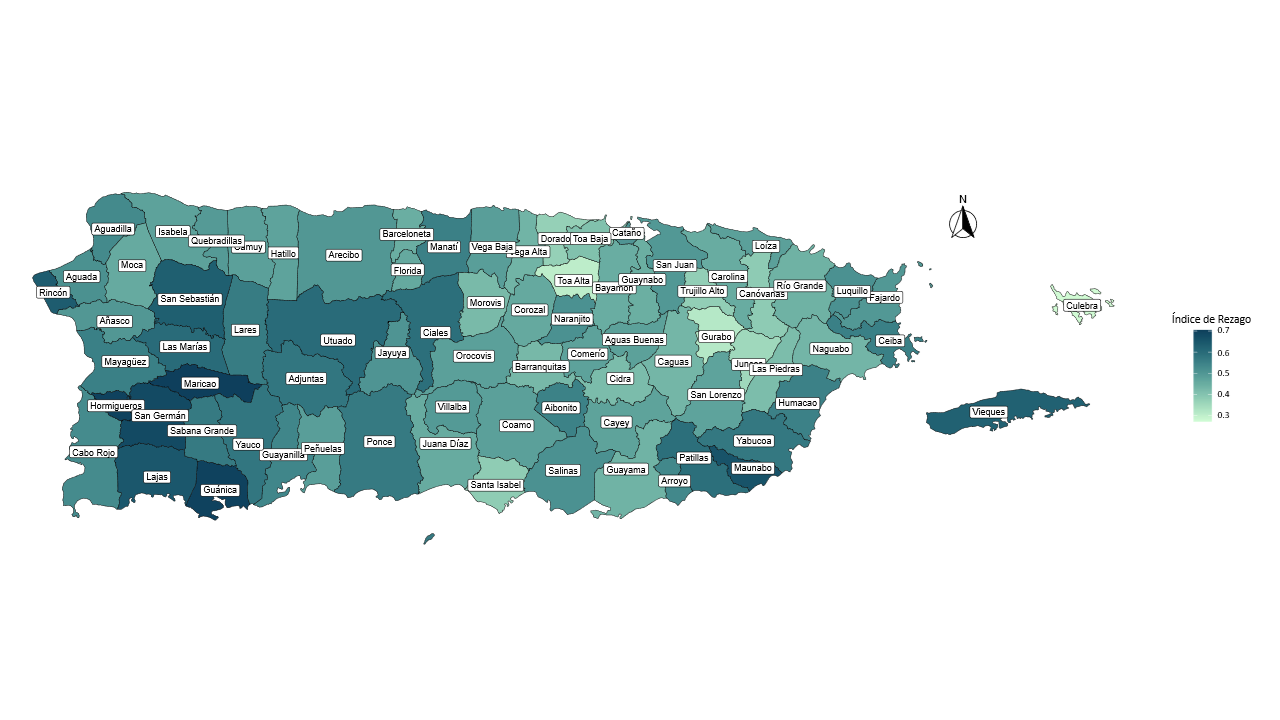
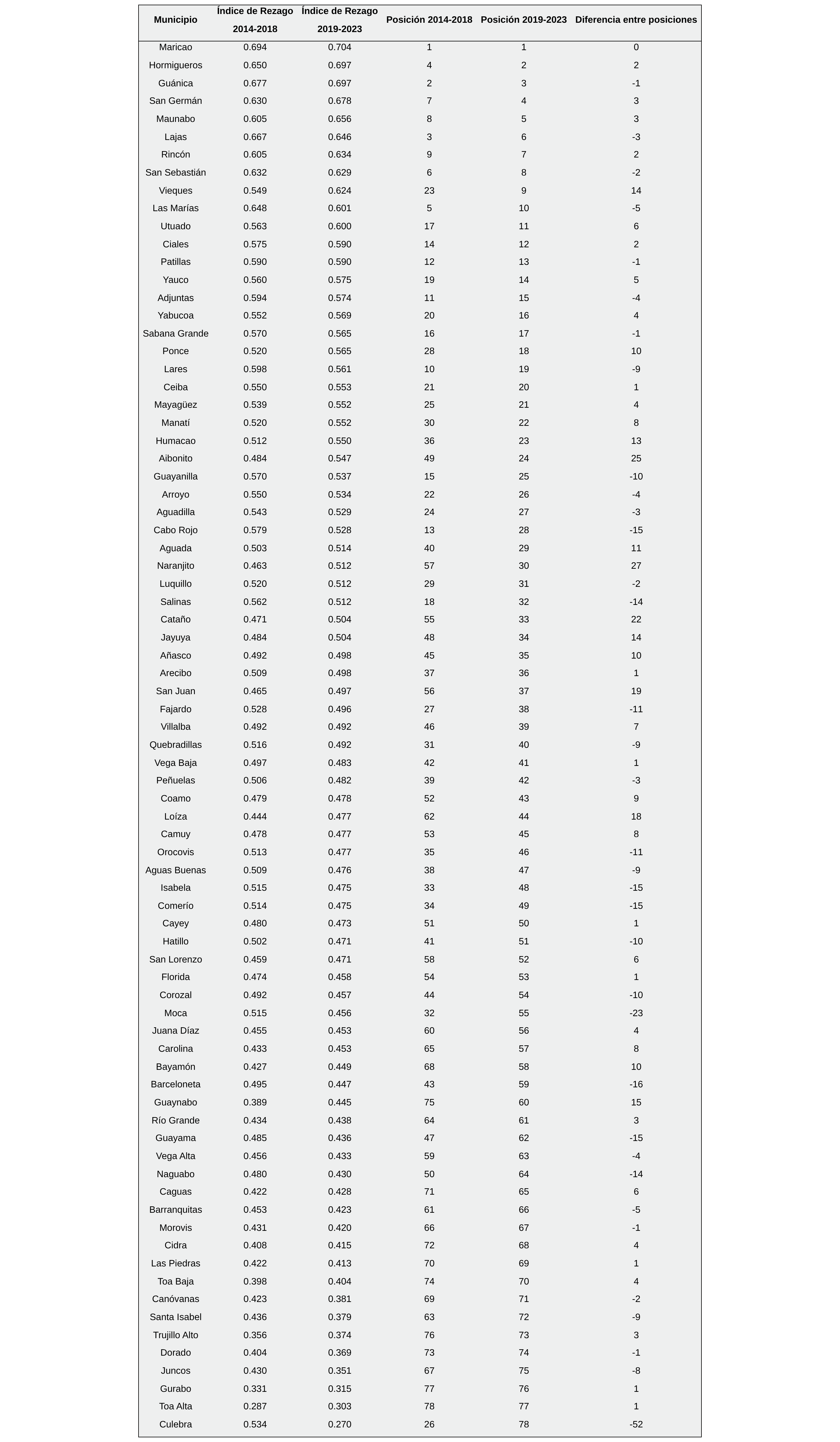
The index was calculated for two comparative periods: 2014-2018 and 2019-2023, allowing us to observe changes in scores and relative positions of municipalities over time. Index values fluctuate between 0 and 1, with a higher score representing a higher relative level of lagging.
The analysis reveals that 42 municipalities showed a decrease in their score of the Lagging Index, which suggests a relative improvement in the conditions measured by the indicator. Of these, 22 municipalities registered a reduction of more than 5%. In the same way, there are concentrations of municipalities with higher scores —indicating greater relative lagging— in the center, south, southwest and southeast regions of Puerto Rico, while several municipalities in the metropolitan area and adjacent to it showed progress compared to the rest of the archipelago.
The municipalities of Culebra, Toa Alta, Gurabo, Juncos, Dorado, Trujillo Alto, Santa Isabel, Canóvanas, Toa Baja and Las Piedras performed better in their relative index in the last period analyzed (2019-2023). However, the Institute stresses that the index is a relative measure and not an absolute measure, so the results must be analyzed within the context and used as a basis for the development of more specific analyses.
“The value of the index is not in pointing out which municipality is better or worse, but in providing an objective basis for analysis, planning and decision-making. It is an opportunity for mayors and officials who participate in decision-making to know their social and economic reality and to develop strategies that respond to the specific needs of their municipalities,” said Dr. Ronald Hernández, Manager of Statistical Projects at the Institute of Statistics of Puerto Rico.
For the elaboration of the Lagging Index, the Institute applied rigorous statistical methods —including exploratory factor analysis, normalization and aggregation of variables—using data from the five-year estimates of the Community Survey of the U.S. Census Bureau And the Bureau of Labor Statistics.
Data
Table 1 shows the results of the Lagging Index at the municipal level for the periods 2014 - 2018 and 2019 - 2023. The table is ordered according to the position of the municipalities based on their index value for the period 2019 — 2023. The higher the index score, the worse or less favorable the outcome of the phenomenon.
Table 1: Lagging Index Results
According to Dr. Hernández, the results of the study highlight the need to design comprehensive public policies that address both the economic aspects and the demographic transformations of Puerto Rico. “The improvements seen in several municipalities are encouraging, but it is essential that socio-economic development efforts are integrated with strategies to respond to the ongoing demographic transition. This includes strengthening geriatric health services, care policies, retention of young people and urban planning adapted to long-lived communities,” said the Institute.”
Hernández indicated that, the Municipal Backwater Index seeks to promote an evidence-based dialogue between the different sectors of Puerto Rico. Its purpose is to serve as a planning and evaluation instrument, which facilitates the identification of areas of opportunity and guides investment decisions, municipal planning and public policy at the central and local levels.”
The Puerto Rico Statistics Institute is an autonomous governmental entity responsible for coordinating the Government's statistical production service to ensure that the data collection and statistics systems, on which public policies are based, are complete, reliable, and have quick and universal access.
For more information you can write to preguntas@estadisticas.pr. They can also follow social networks through Facebook (@estadisticas .pr), X (@EstadisticasPR), LinkedIn (Institute of Statistics of Puerto Rico) and Instagram (@institutodeestadisticas) accounts.


-p-130x130q80.png)
.png)
.png)
.png)
.png)
.png)
.png)
.png)
.png)
.png)
.png)
.png)

.png)
.png)
.png)
.png)