
Call for paid internships at the Institute of Statistics

Announcements
IEPR
24 December 2025

PRESS RELEASE

Call for paid internships announced at the Puerto Rico Institute of Statistics

Students in statistics, mathematics, computer science, public administration, and others may apply

The Puerto Rico Statistics Institute announced that, for the next two weeks, and as long as the available spaces are filled, the call for paid internships will be open for graduate students in statistics, mathematics, computer science or in any other area in which extensive use is made of statistics, including economics, planning, demography, epidemiology, biostatistics, criminology, sociology, public policy, public administration, business administration or other related ones. The opportunity also extends to undergraduate students, from any of the above-mentioned disciplines, who are candidates for graduation in the same academic year in which they participate in the program.

Those selected will have the opportunity to collaborate directly with professionals from the Institute, who have extensive experience in the fields of economics, epidemiology, education, demography, statistics, programming and administration, among others. In the same way, they will receive support from the Institute's staff in the major projects they carry out according to the area in which they are assigned. All this, as indicated, in a work and learning environment that allows them to apply their knowledge in a professional environment.

“We are pleased to offer this opportunity to graduate students, or undergraduate candidates for graduation, as they will not only gain experience, but we also help them prepare for the professional field of work. In the same way, it is always good to share with the new generations that they have a lot to contribute, particularly in one of the most developed areas in Puerto Rico, such as statistics,” said Dr. Orville M. Disdier, executive director of the Puerto Rico Institute of Statistics, who added that, among the applicants, they are interested in identifying candidates with knowledge in Geographic Information Systems (GIS), Microsoft Power BI, SQL and Python, and others.

It was reported that interested parties must complete an application that is available at Programa_Internado_2025_IEPR.pdf where, in addition, the requirements and documents they must provide are detailed. Once the application is completed, it must be sent along with the documents to the following email: programadeinternado@estadisticas.pr. The Puerto Rico Statistics Institute will receive the requests and they will go through an evaluation process. Applicants will then receive a formal notification with the decision made.

For more information, those interested who meet the requirements can contact Mrs. Rebeca Ortiz, Office Manager at the following email: rebeca.ortiz@estadisticas.pr.

The Internship Program of the Institute of Statistics of Puerto Rico was created to promote the professional development of undergraduate students or graduates of university programs in statistics or related sciences at universities in Puerto Rico and other jurisdictions in the United States, to collaborate with the projects, studies and work carried out at the Institute.

‍

Share this article:

Please let us know your satisfaction level with our services.

‍

Visit our Official Activities, and participate with us

Visit our Calls for applications and be part of the new opportunities we have for you.

If you have any questions or just want to contact us, visit the Contact Us section.

We are at your disposal. If you need custom statistics, do not hesitate to contact us.

Sign up for our online workshops. Connect with the experts and discover the power of data!

Visit our Blog and keep up to date with the latest news and topics of interest.

Visit our Press Releases and stay connected to the Institute.

Explore the Publication Calendar and keep up to date with Puerto Rico's statistics.

Complete the form for the selection of our Statistics Coordination Committee

Suscribe to receive news directly to your email.

Listen to the Official PRIS podcast and stay informed with the experts

They present economic and social indicators for Puerto Rico

They present economic and social indicators for Puerto Rico

In activity between the Puerto Rico Institute of Statistics and the United States Census Bureau

San Juan, Puerto Rico. October 24, 2024. The Puerto Rico Statistics Institute, in collaboration with the United States Census Bureau, presented the conference “Economic and Social Indicators on Puerto Rico: Exploring the Economic and Social Reality of Puerto Rico”, in which they examined the main economic and social indicators that impact Puerto Rico. Experts from the United States Census Bureau and the Puerto Rico Institute of Statistics presented key issues, such as the cost of living, labor force, community resilience and migratory flow, among others. The activity took place on October 4. “Knowing some of the indicators that reflect the economic and social reality of Puerto Rico is essential for the development of effective public policies. This collaboration with the Census Bureau helps us to have more accurate and reliable data that will help us better understand the challenges and opportunities facing Puerto Rico,” said the executive director of the Puerto Rico Institute of Statistics, Dr. Orville M. Disdier.

For his part, Michael López-Pelliccia, (Chief of Staff, Economic Department) of the United States Census Bureau in Puerto Rico, said that, “The opening of the first Federal Center for Statistical Data Research in Puerto Rico (FSRDC) and events such as this conference are part of an ongoing effort to strengthen technical capacity in Puerto Rico. Through seminars, workshops, and webinars, we seek to provide local people with a more practical and accessible approach to using Census data. This type of technical assistance is key to ensuring that Puerto Rico can make the most of the wealth of information we offer.”

The conference included presentations by experts such as Ana G. Jara Castro, Clara E. Santiago Bello, Javier Gómez and Marijulie Martínez from the United States Census Bureau, who addressed issues such as building permit indicators and the “Census Business Builder” tool, among others. On behalf of the Puerto Rico Institute of Statistics, Dr. Ronald G. Hernández Maldonado presented the Cost of Living Index, while Alberto L. Velázquez Estrada spoke about the migratory flow and the structure of the labor group in Puerto Rico.

Among the various indicators presented at the conference, the following stood out:

  • El Quarterly Workforce Indicators which includes 32 labor force indicators that cover employment, job changes and income. This is a single work-level data source that provides demographic information on the labor market.
  • The Community Resilience Estimates (CRE), which are modeled estimates of vulnerability factors in the population such as functional diversity, poverty level, access to vehicles and internet, employment, education, and others, combining data from the Community Survey.
  • The tool Census Business Builder, which is a customer-focused application. It provides access to data to develop business plans, request financial assistance, study economic development, plan strategies and create emergency plans.
  • The Internet page Puerto Rico Profile which links between its tools automated profiles for municipalities with data on employment, poverty, income, education and health, among others.
  • The Cost of Living Index (COLI). This reflected in the most recent results for Puerto Rico, that the cost of grocery items in San Juan, Bayamón and Caguas is 12.2% more expensive than the average of the participating urban areas in the United States.
  • Regarding the Migratory Flow and Structure of the Working Age Group in Puerto Rico, it was highlighted that emigration has been a constant in the history of Puerto Rico, but this has taken a deep toll on the working population in recent years. About 70% of working-age emigration occurred at ages 16 to 44.

The presentations and materials used during the conference are available through the following link: https://estadisticas.pr/en/Conferencia-Indicadores-Económicos-y-Sociales.

The Puerto Rico Statistics Institute is an autonomous governmental entity responsible for coordinating the Government's statistical production service to ensure that the data collection and statistics systems, on which public policies are based, are complete, reliable, and have quick and universal access.

For more information you can visit the website: www.estadisticas.pr or write to preguntas@estadisticas.pr. They can also follow social networks through Facebook (@estadisticas .pr), X (@EstadisticasPR), LinkedIn (Institute of Statistics of Puerto Rico) and Instagram (@institutodeestadisticas) accounts.

Authorized by the Office of the Electoral Comptroller OCE-SA-2024-12788

‍

Statistics Institute publishes the Statistical Compendium on Higher Education in Puerto Rico: Year 2020-2021

Statistics Institute publishes the Statistical Compendium on Higher Education in Puerto Rico: Year 2020-2021

As in the previous year, enrollment continued to decline in Puerto Rico's post-secondary university education system in 2020-2021. This publication includes a new section on “Students enrolled in distance education courses by sector”. Access the report in its entirety through the following link: Statistical Compendium of Higher Education (IPEDS)

The population of Puerto Rico is estimated at 3.2 million in 2018

PRESS RELEASE

RED STATE DATA CENTER OF PUERTO RICO

December 19, 2018

THE POPULATION OF PUERTO RICO IS ESTIMATED AT 3.2 MILLION IN 2018

With the post-hurricane effect, it points to a decrease of 14% since the 2010 Decennial Census

San Juan, PR — El U.S. Census Bureau released today the most recent annual population estimates for Puerto Rico. These statistics refer to July 1, 2017 and include the components of annual population change since July 1, 2010, which support the population estimate since the beginning of the decade. As the leading entity of the Network State Data Center (SDC) of the U.S. Census Bureau in Puerto Rico, the Puerto Rico Statistics Institute (Institute) presents this summary of the findings of the new annual population estimates for 2018:

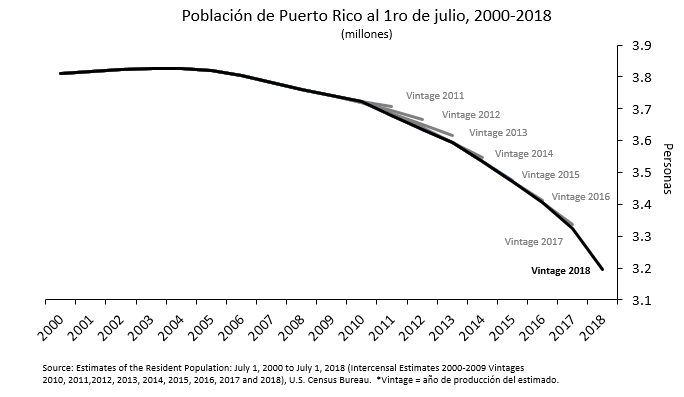
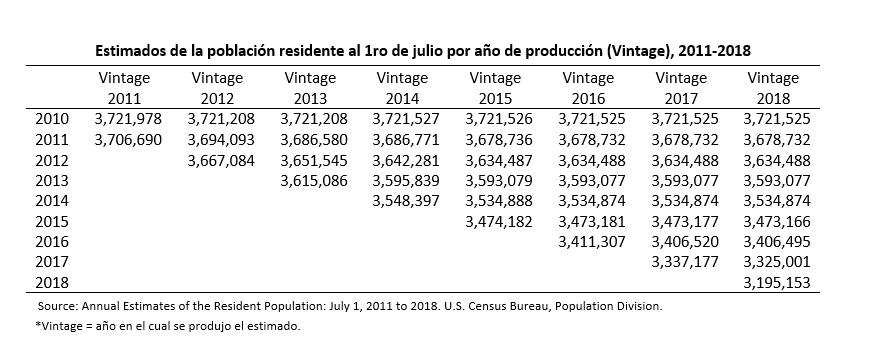
  1. The population of Puerto Rico was estimated at 3,195,153 people as of July 1, 2018.
  2. The impact of the hurricanes (Irma and María) in 2017 is included in the new estimates. These hurricanes further fueled the downward trend in population size in Puerto Rico. The absolute population change between July 2017 and 2018 was estimated to be close to 130,000 inhabitants, representing 3.9% of the total population.
  3. Compared to the last 2010 Census, when the official list resulted in 3,725,789 people, the new estimate points to a cumulative decrease in the current decade of close to 14% until 2018.
  4. In relation to the resident population 18 years of age or older (of voting age), this was estimated at 2,601.142 million, comprising 81 percent of the population in Puerto Rico.
  5. The components of population change include that, between July 1, 2017 and July 1, 2018, about 24,000 births and 31,000 deaths occurred in Puerto Rico. As a result, annual population estimates reflect more deaths than births, resulting in a natural increase close to -6 thousand people. Regarding migration, the estimated net balance was approximately -123 thousand people during the same period.

“The 2018 population estimates give a little more detail to the repercussions of the hurricanes of the past year 2017 on the demographic components of Puerto Rico. The combination of a negative natural increase in the population (more deaths than births), combined with the drive of the already high net emigration, points to an impressive population loss of 3.9% in just one year. This presents us with a difficult scenario to assimilate in terms of the speed of the decrease, as well as the direct repercussions it entails on the local scene. On the other hand, the operations of the next Decennial Census 2020 are becoming more important, so that they result in the best possible official enumeration, then you can confirm the drastic demographic changes estimated during the current decade,” said Alberto L. Velazquez Estrada, Manager of Statistical Projects at the Institute.

After the completion of a Decennial Census (such as the 2010 Census) the U.S. Census Bureau prepare the annual population estimates, which allow us to approximate the population during the decade before the next Census. These estimates are prepared by analyzing data on births, deaths and migration. As a result, with each new publication of the estimates, adjustments are made to the previously estimated years. For example, with the publication of the 2018 estimates announced in this release, the estimates already published for 2011, 2012, 2013, 2014, 2015, 2016 and 2017 were revised. Each publication is distinguished according to the year in which they were produced and are named as Vintage.

More statistics on Puerto Rico's annual population estimates can be obtained at: https://censo.estadisticas.pr/EstimadosPoblacionales, in the population estimates section. Information on the methodology used to produce the estimates can be accessed hither.

The Puerto Rico Statistics Institute is an autonomous governmental entity responsible for coordinating the Government's statistical production service to ensure that the data collection and statistics systems, on which public policies are based, are complete, reliable, and have quick and universal access. The Institute has in its inventory, accessible through www.estadisticas.pr.gov, over 300 statistical products. In addition, it is a custodian and provides access to over 100 data sets or Data sets by means of www.data.pr.gov and to over 40 tables and more than 6 thousand indicators through: www.indicadores.pr

For more information you can visit our website: www.estadisticas.pr.gov. In addition, you can follow us on social networks through Facebook accounts (statistics.government.pr), Twitter (@EstadisticasPR) and LinkedIn (Institute of Statistics of Puerto Rico).

###

Press Contact: Sandra Morales Blanes: (787) 688-0401

‍